Science games where kids run the experiment.
Kids don't learn science by watching videos — they learn it by breaking things and finding out why. Every game here is a small experiment your child runs with their hands: predict, test, explain. Ako, the voice AI tutor, is alongside the whole time.
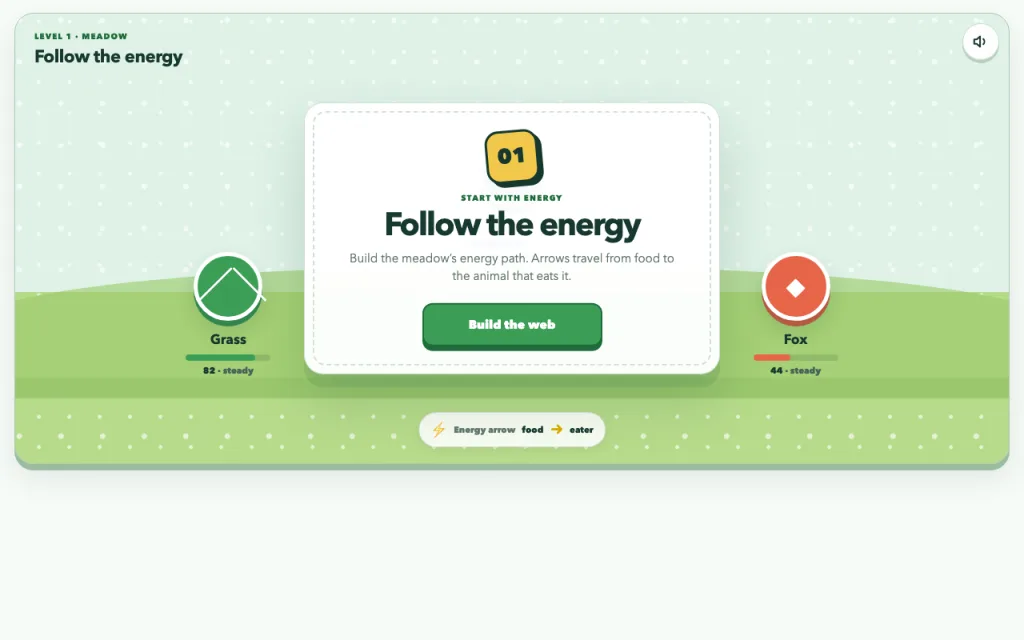 Biology · Ages 8-13Food Web Balance
Plants, plant-eaters and predators keep each other in check, so adding or removing one species ripples through the whole food web — even to species it never touches.
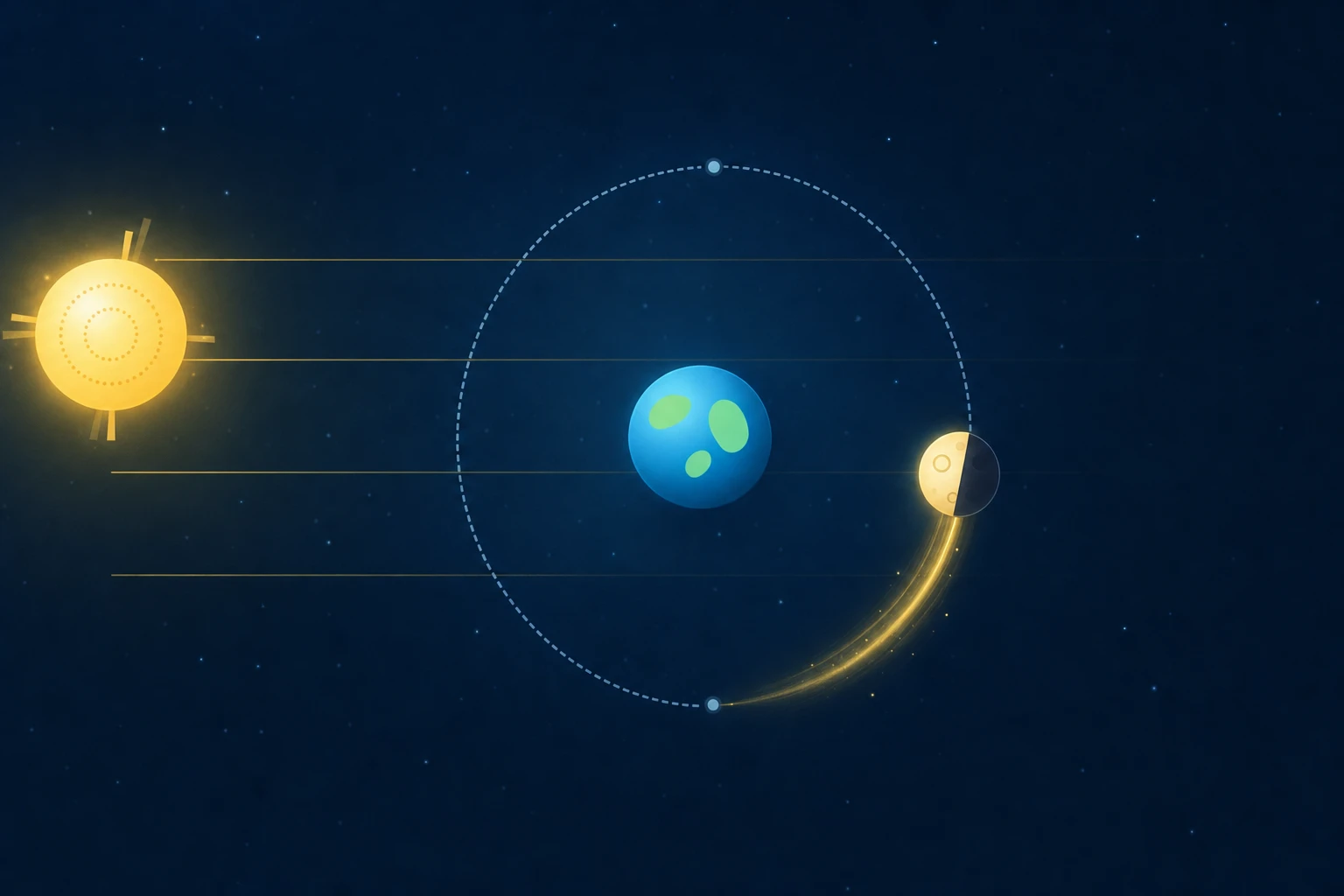 Earth and Space Science · Ages 9-12Moon Phases Lamp
The Sun always lights half the Moon; as the Moon moves around Earth, our changing view of that same lit half makes the phases repeat in order.
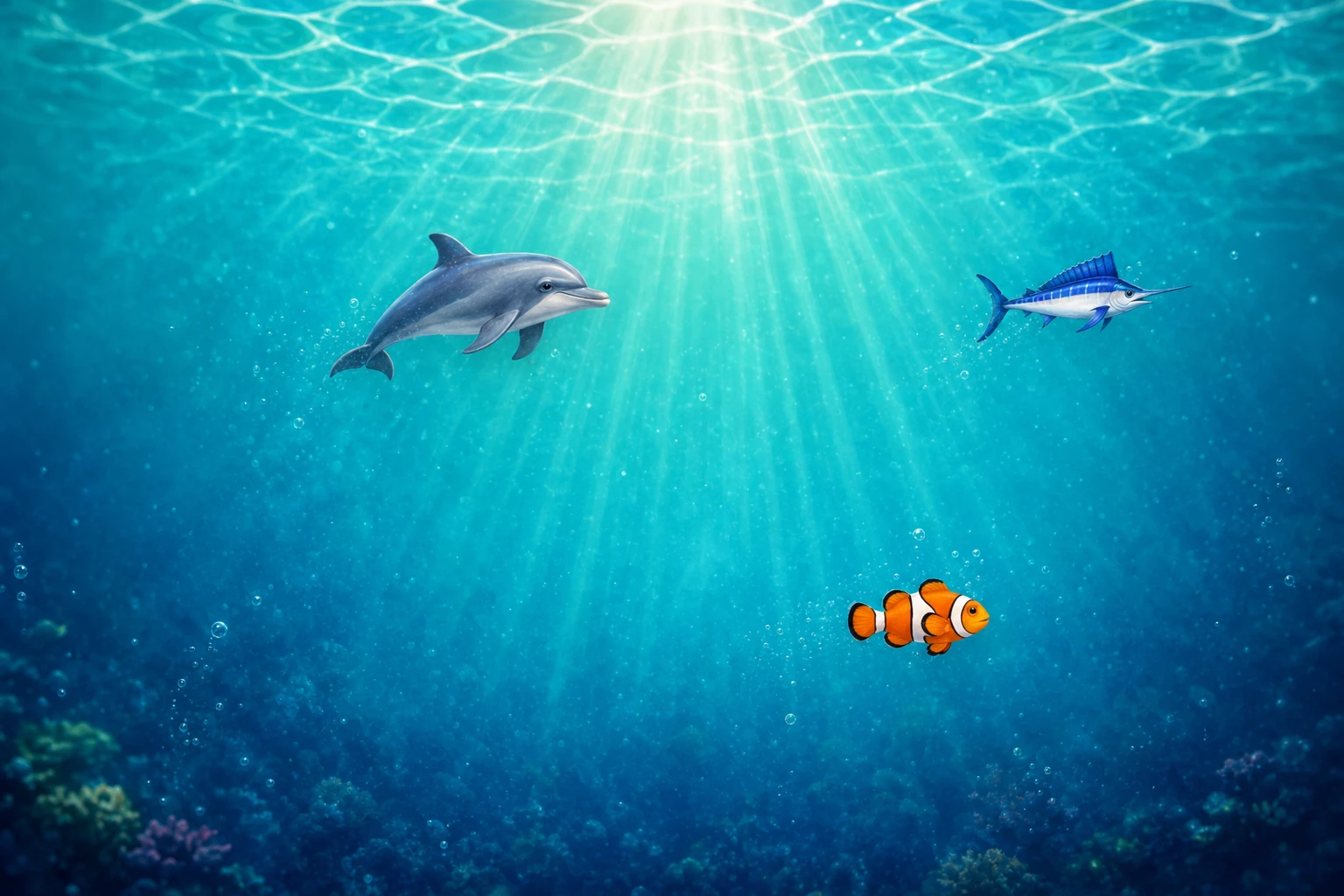 Life and Earth Science · Ages 7-12Ocean Deep
The ocean changes in zones with depth: sunlight fades, temperature falls, and pressure rises, so animals need different adaptations to live at different depths.
Earth science · Ages 10-14Live Fault TableEarthquakes occur when accumulated tectonic stress exceeds fault resistance; released energy depends on several source factors, P and S waves travel differently, and observed impact emerges through source, path, site, and structure.
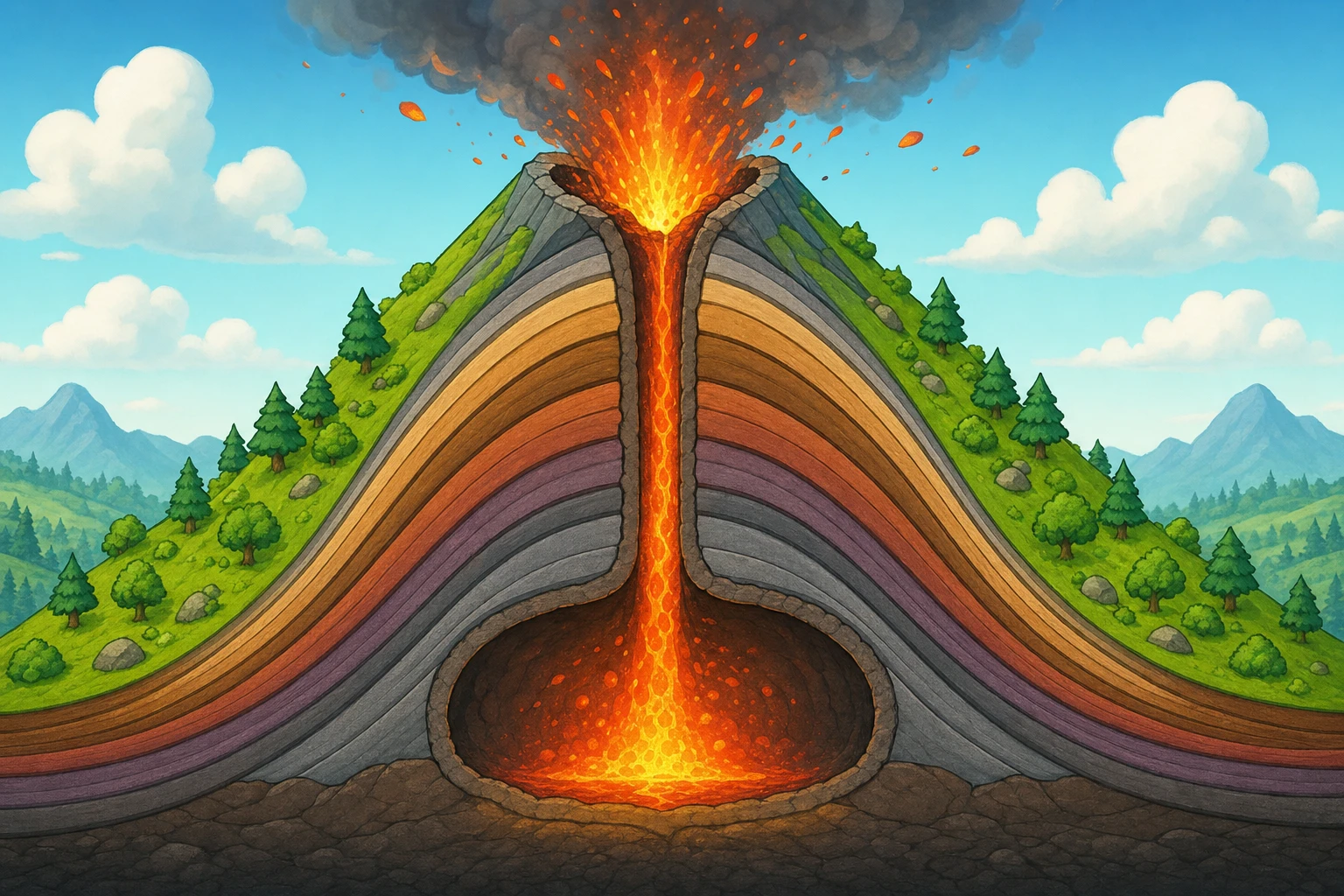 Earth Science · Ages 9-13Volcano Inside
Heat and expanding trapped gas build pressure in a magma chamber; that pressure forces magma up a vent, and more stored pressure produces a bigger eruption.
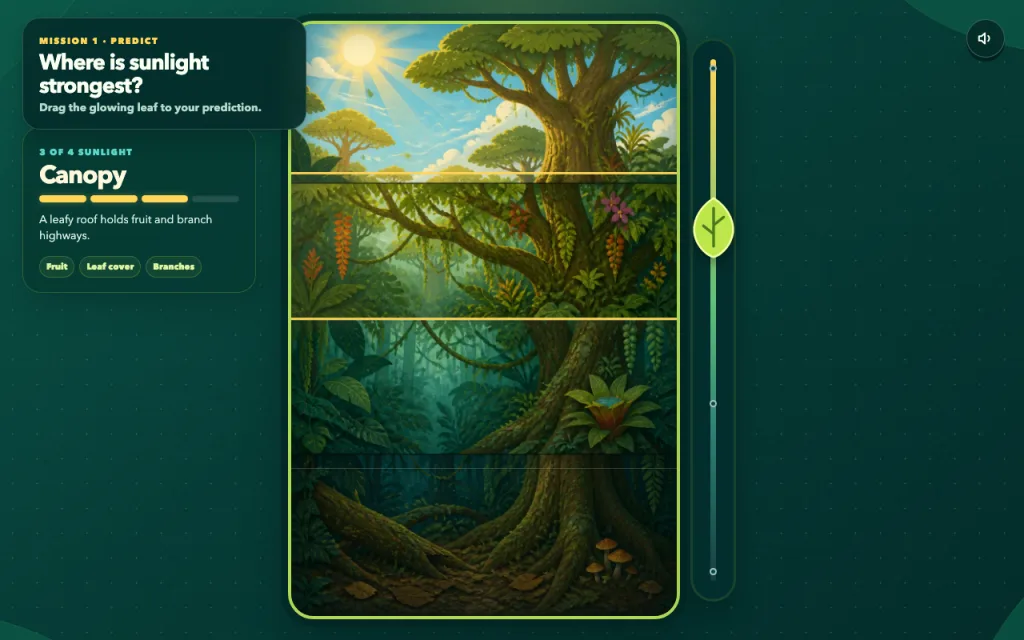 Ecology · Ages 8-12Rainforest Layers
A rainforest has four vertical layers, and different animals fit each layer because light, food, movement routes, moisture, and safety change from top to bottom.
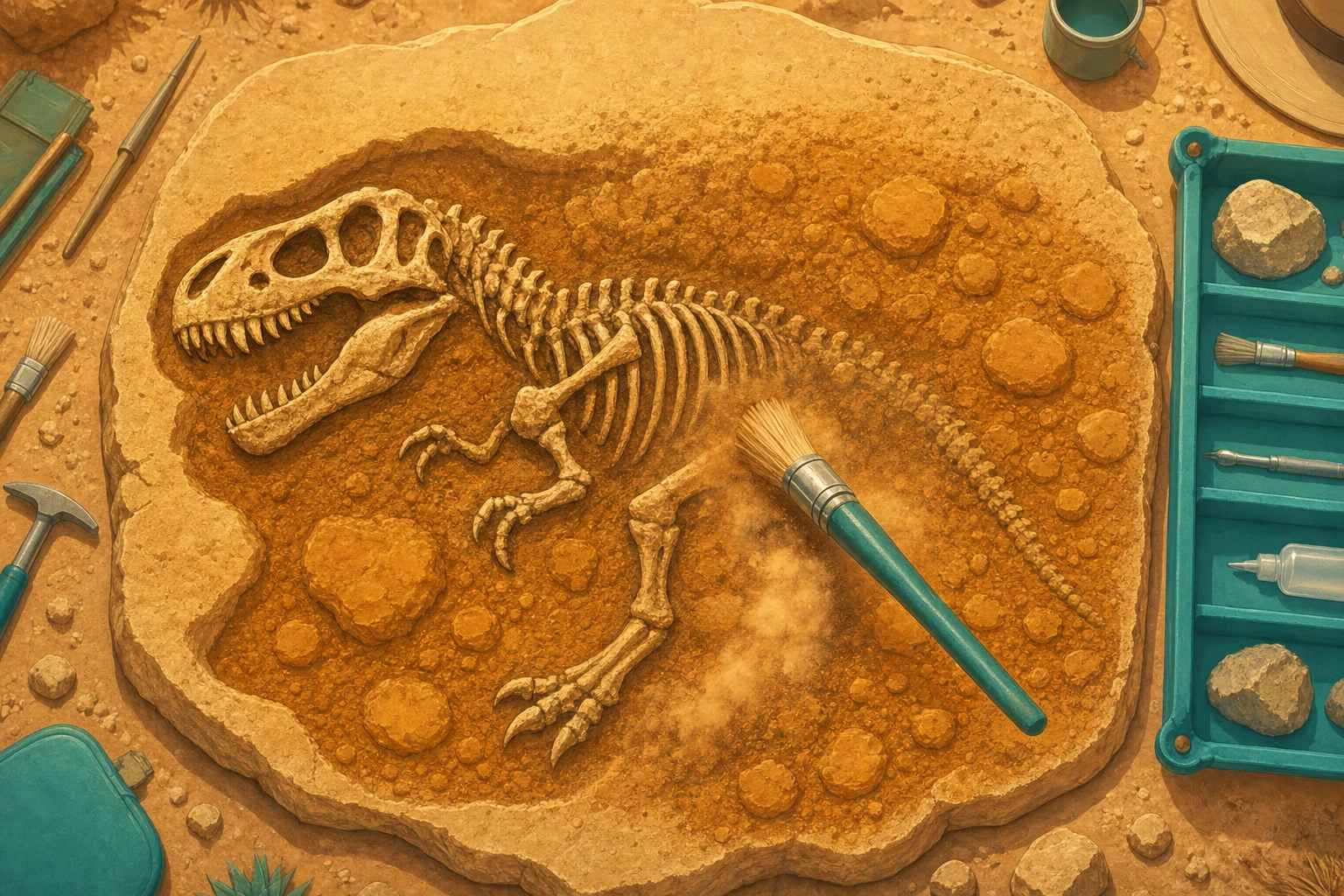 Earth and Life Science · Ages 8-12Fossil Dig
Fossils are clues preserved in rock; palaeontologists carefully uncover their shapes and positions, then fit that evidence together to infer what an extinct animal looked like.
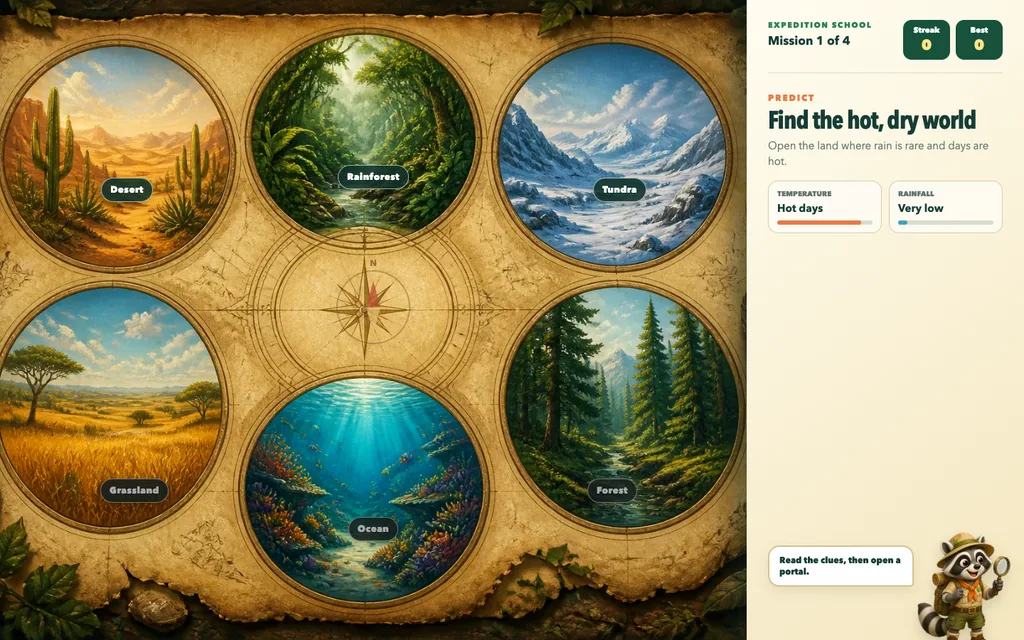 Science · Ages 7-13Biome Explorer
A biome's long-term temperature and rainfall shape its vegetation, which determines which plants, animals, and food chains can survive there.
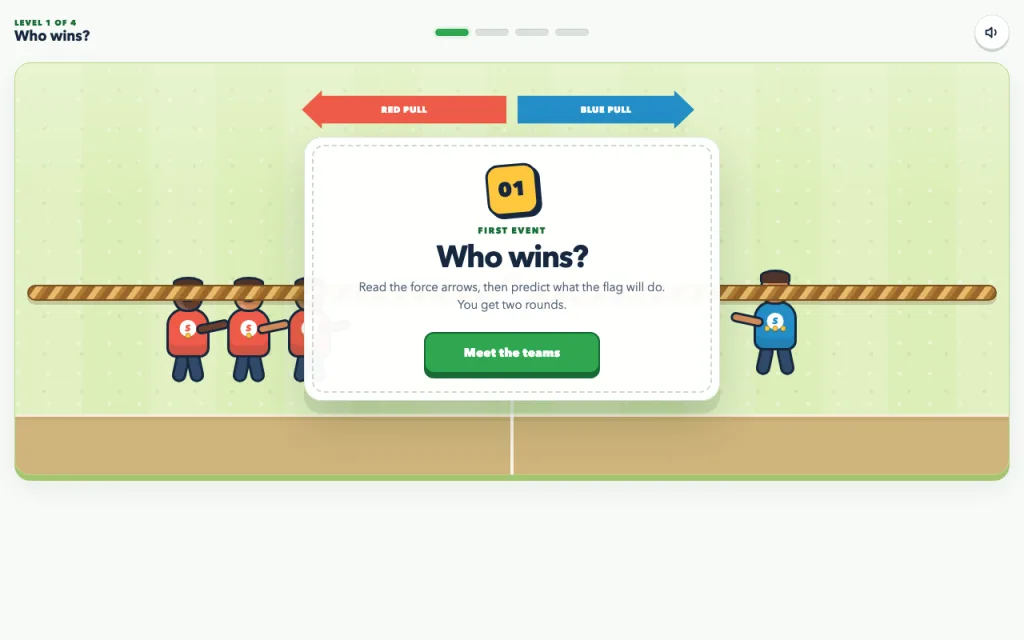 Physics · Ages 8-11Forces Tug of War
Equal opposing forces balance and keep an object still; when one opposing force is bigger, the object moves in that force's direction, regardless of headcount.
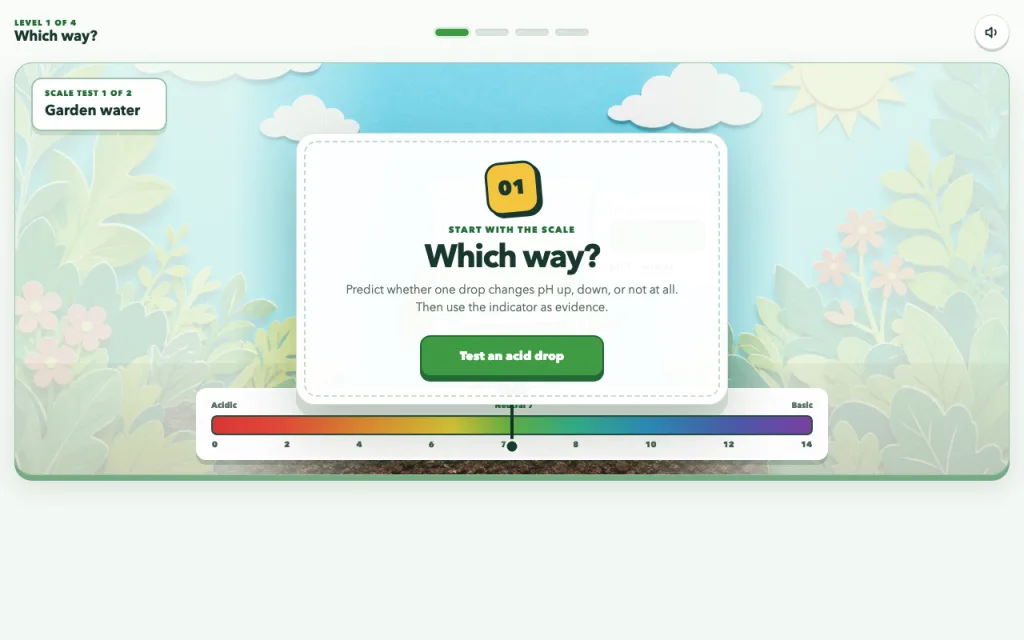 Chemistry · Ages 10-13Acids and Bases Garden
pH measures how acidic or basic a solution is: acid lowers pH, base raises pH, and neutral is 7.
Science · Ages 5-11Aotearoa BirdsAotearoa New Zealand’s native birds can be recognised respectfully by distinctive visible features such as bill shape, feather markings, body shape, legs, eyes, and tail.
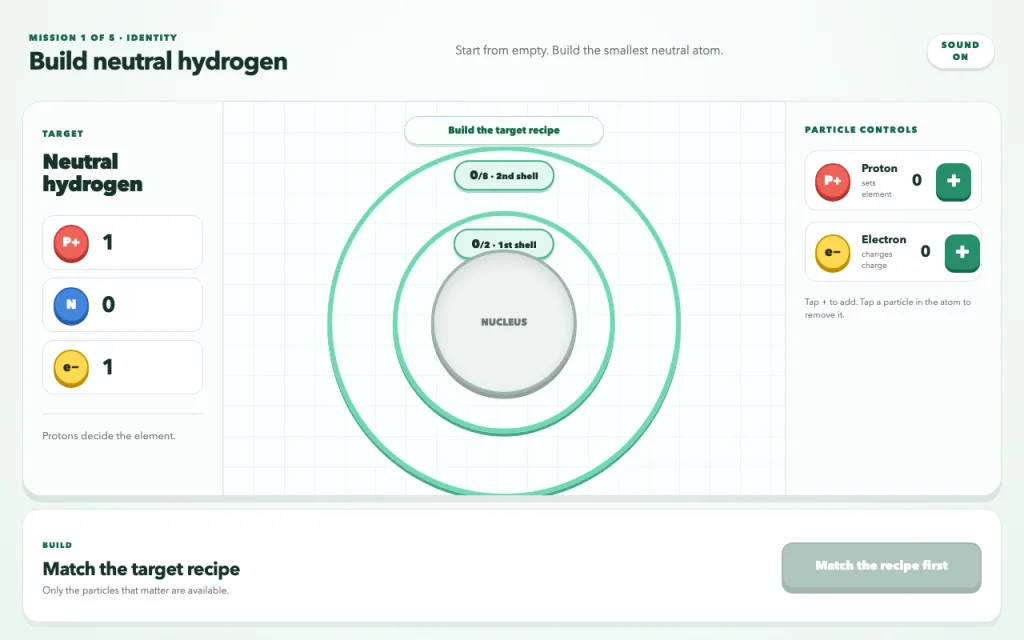 Chemistry · Ages 10-13Atom Forge
Protons decide which element an atom is, neutrons change its isotope and mass, and electrons change its charge.
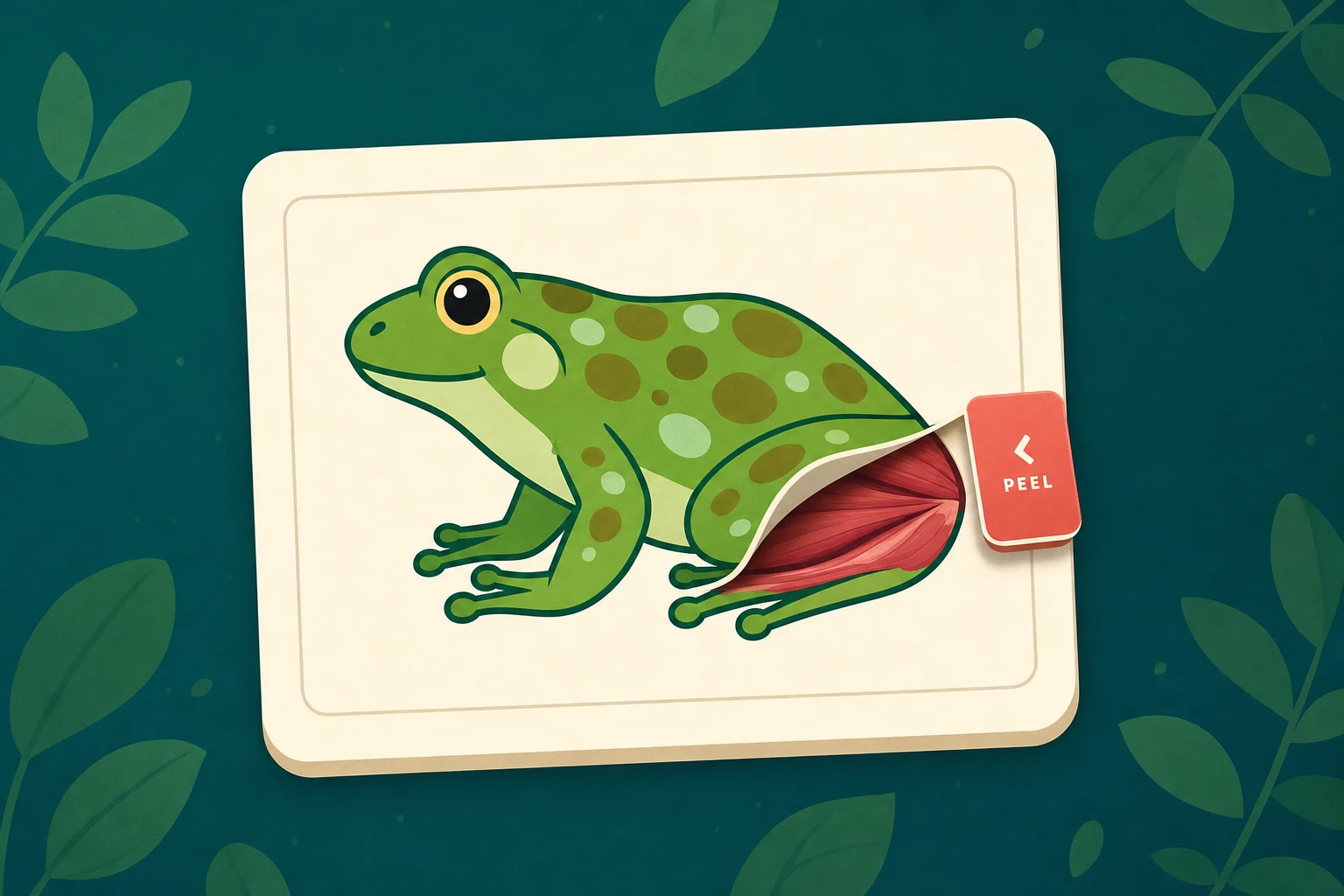 Life Science · Ages 9-13Body Explorer
Animal bodies contain fitted layers—skin, muscles, organs, and skeleton—that work together inside differently shaped animals.
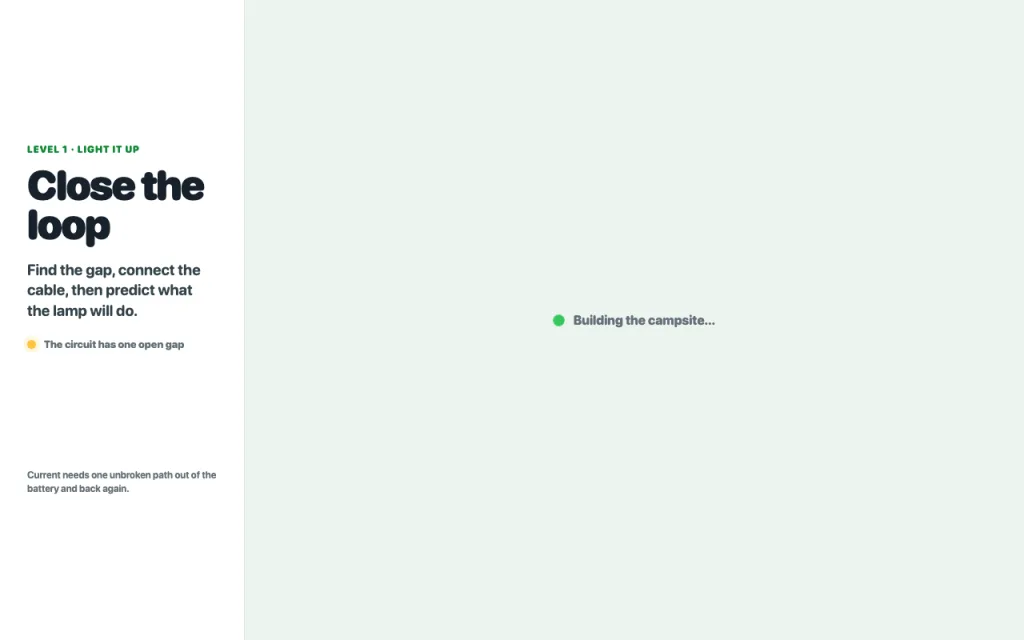 Physics · Ages 8-11Circuit Rescue
Electric current flows only around one complete, unbroken loop; a switch controls that loop but is not the same as a broken wire, and every component in a series circuit shares the same route.
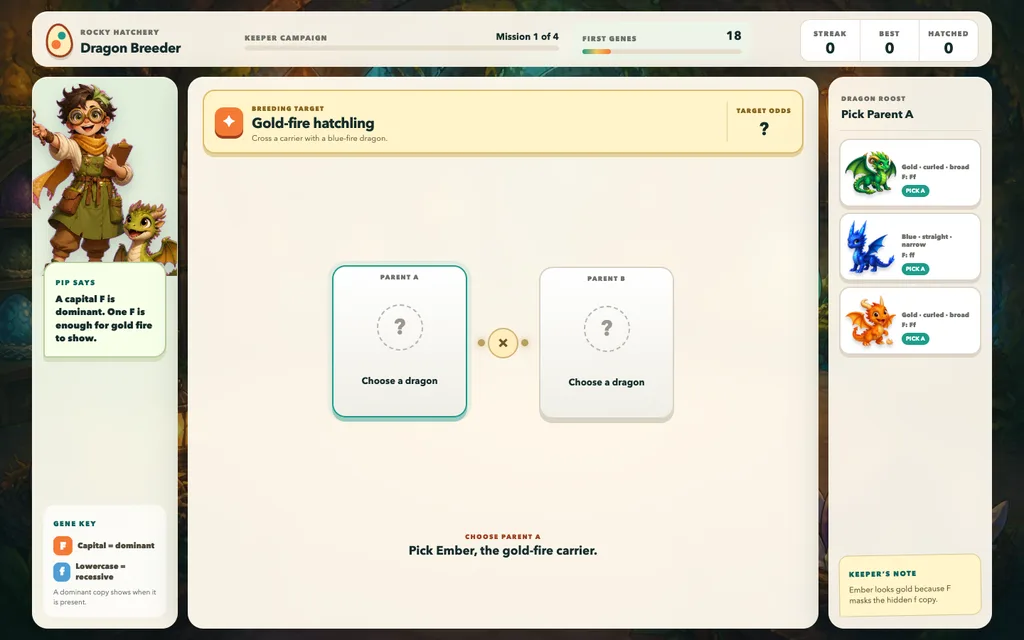 Biology · Ages 10-13Dragon Breeder
An offspring receives one allele for each gene from each parent; dominant alleles can mask recessive alleles, and a Punnett square predicts probabilities rather than guaranteeing one outcome.
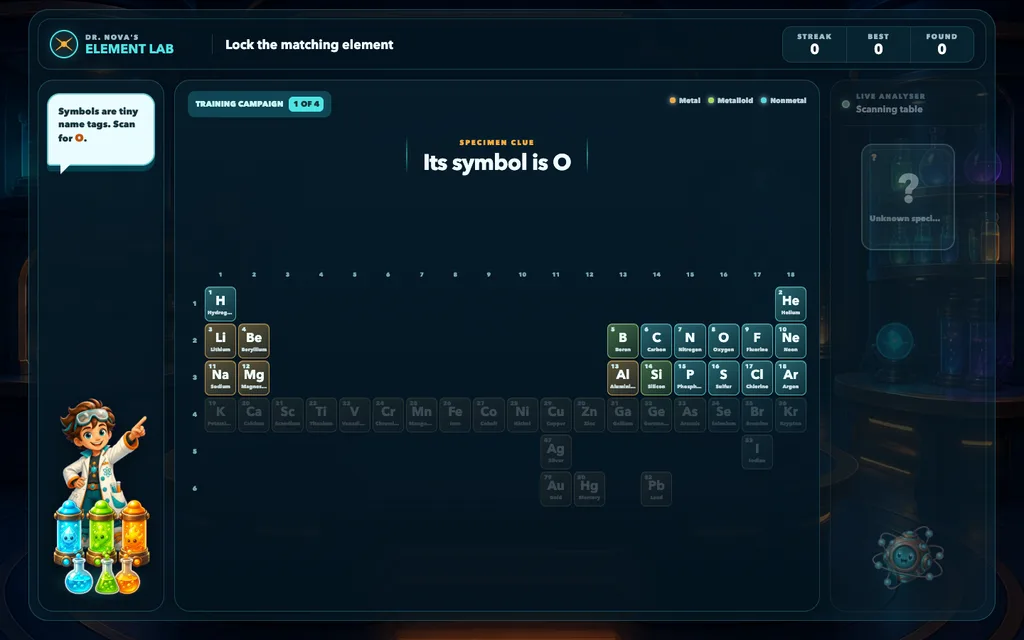 Chemistry · Ages 10-13Element Lab
The periodic table is a map: atomic number identifies an element by its proton count, periods are rows, groups are columns with related properties, and symbols are short element names.
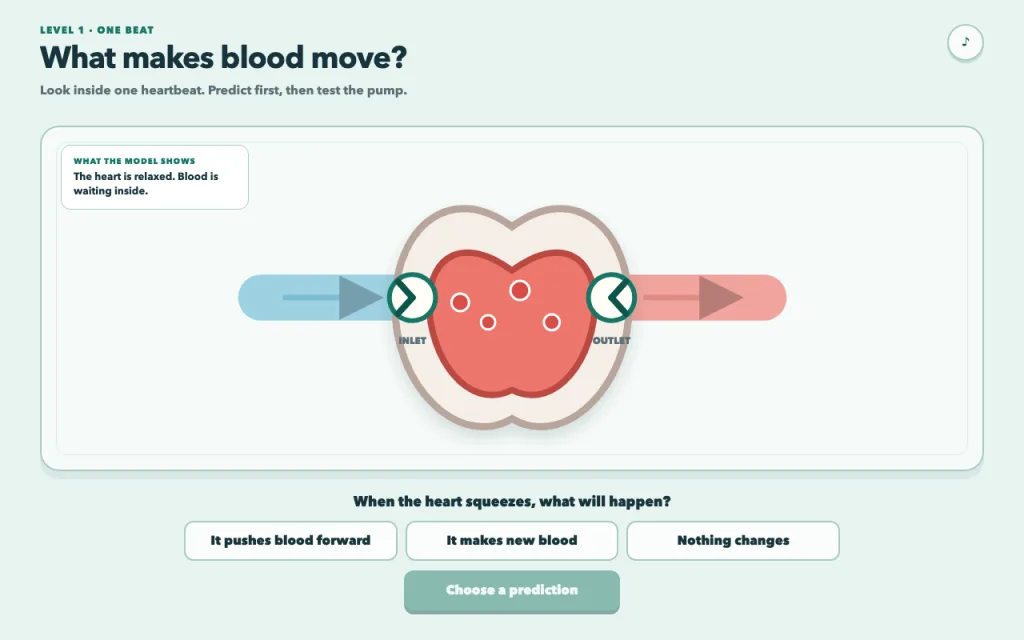 Biology · Ages 10-13Heart Pump Lab
The heart is a pump: each muscle squeeze raises pressure, one-way valves direct that pressure into forward blood flow, and body demand changes how quickly the pump repeats.
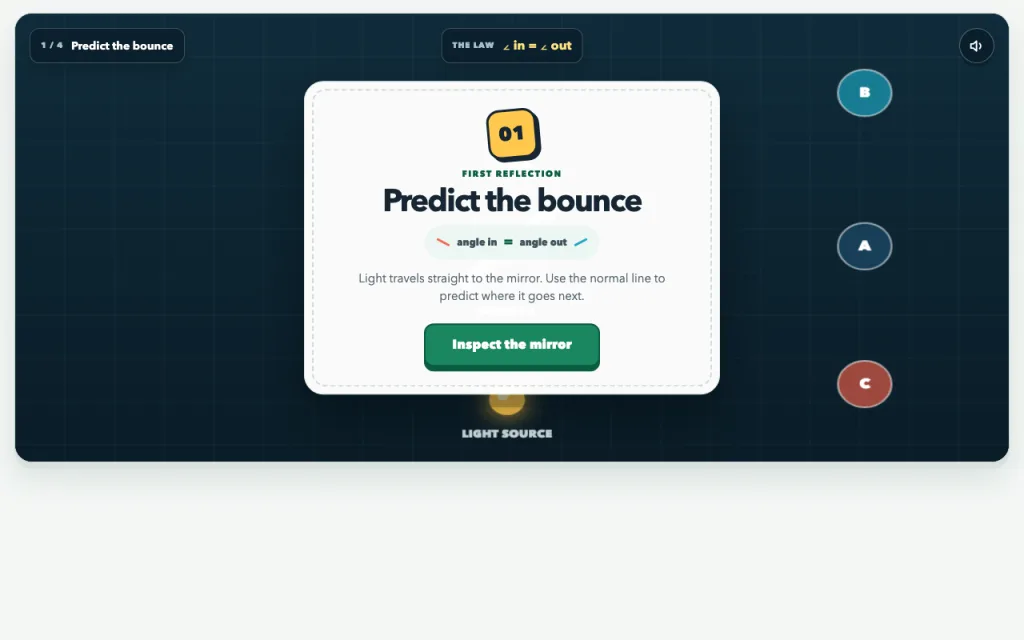 Physics · Ages 10-13Light Reflection Maze
Light travels in straight lines and reflects from a mirror so its angle away from the normal equals its angle toward the normal.
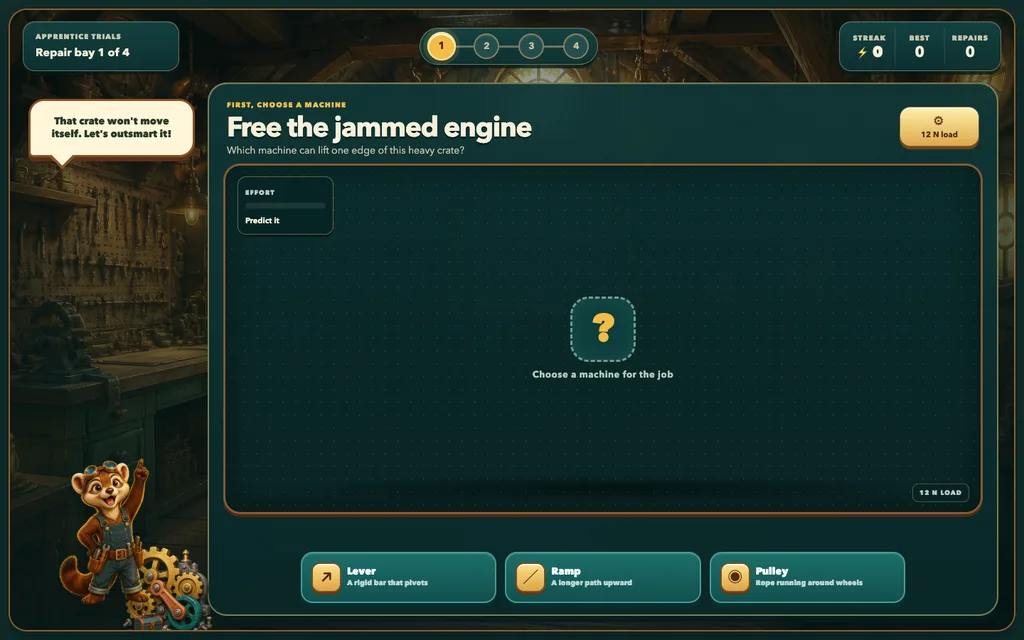 Physics · Ages 8-13Moss & Cog Workshop
Simple machines make jobs easier by trading force for distance or changing the direction of a force; they do not remove the load's weight or create energy.
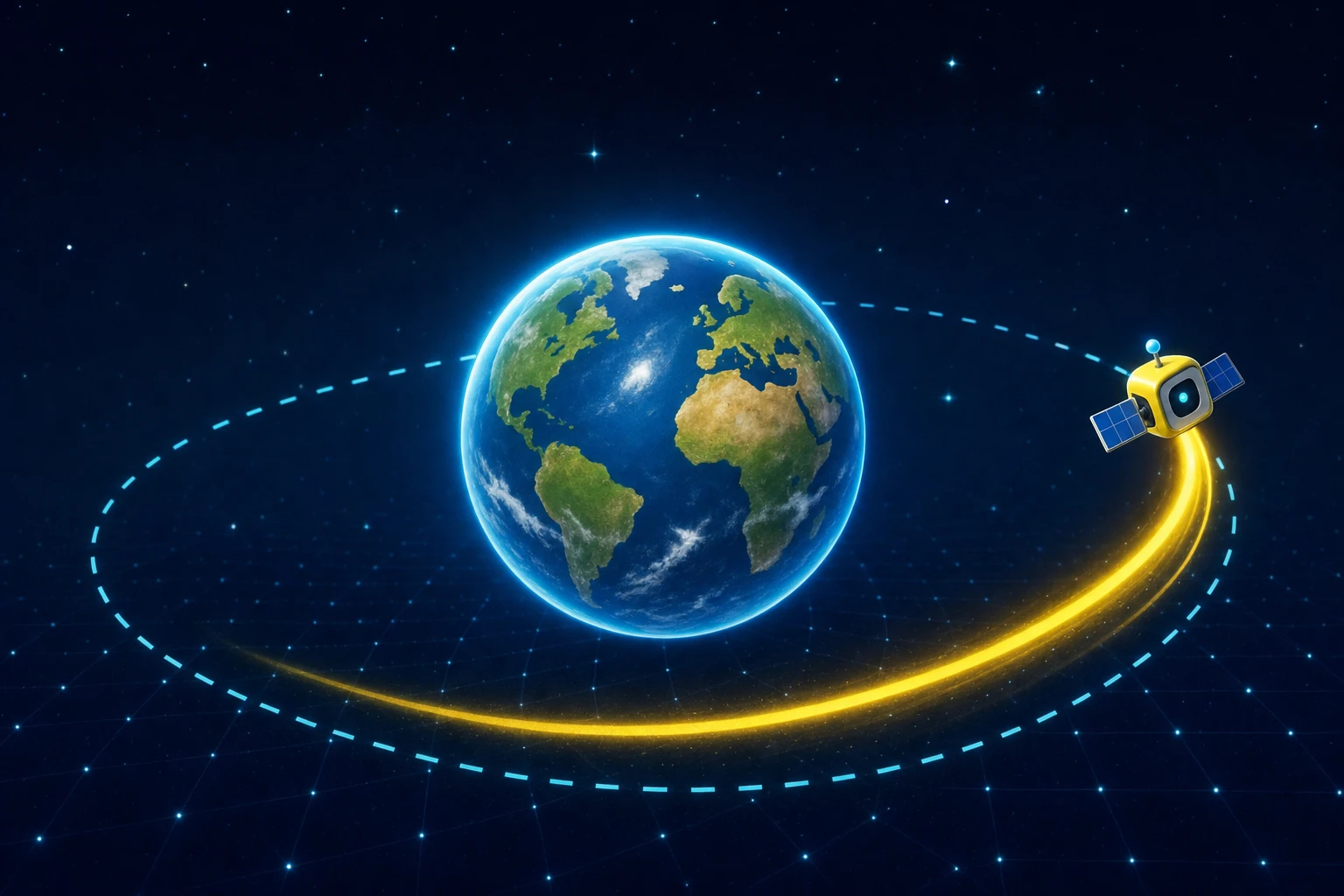 Physics · Ages 11-13Orbit Lab
An orbit is constant falling: gravity bends sideways motion around a planet, while too little sideways speed crashes and too much escapes.
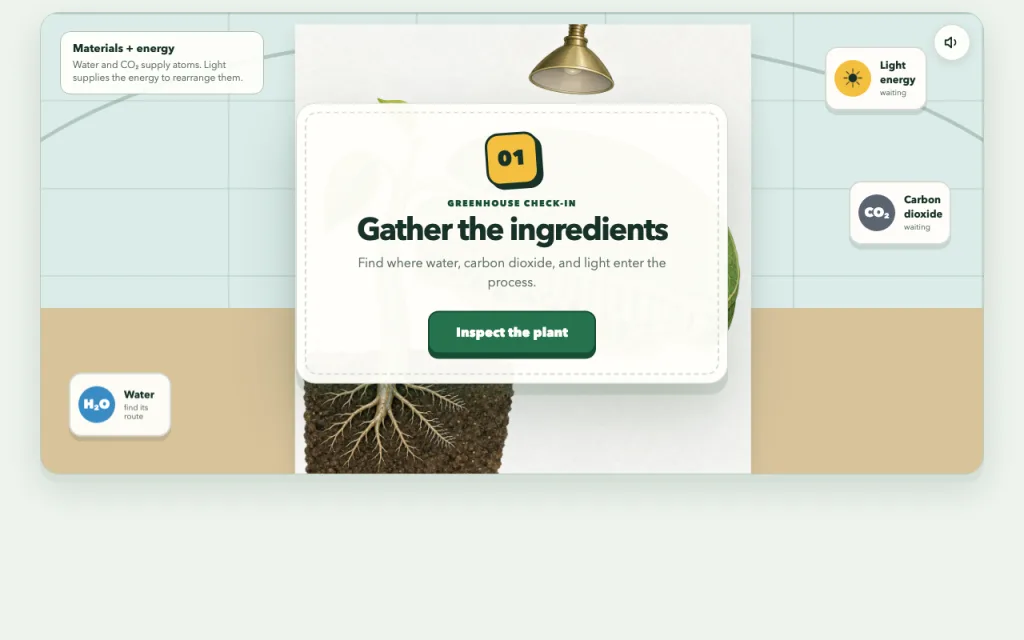 Biology · Ages 9-12Photosynthesis Greenhouse
Plants use light energy to rearrange atoms from water and CO₂ into sugar and oxygen; atoms regroup rather than appearing, and the scarcest required input limits production.
Science · Ages 4-9Plant PartsEach plant part has a distinct job, and roots, stems, leaves, flowers, and seeds work with sunlight, water, and air to help the whole plant live, grow, and begin a new generation.
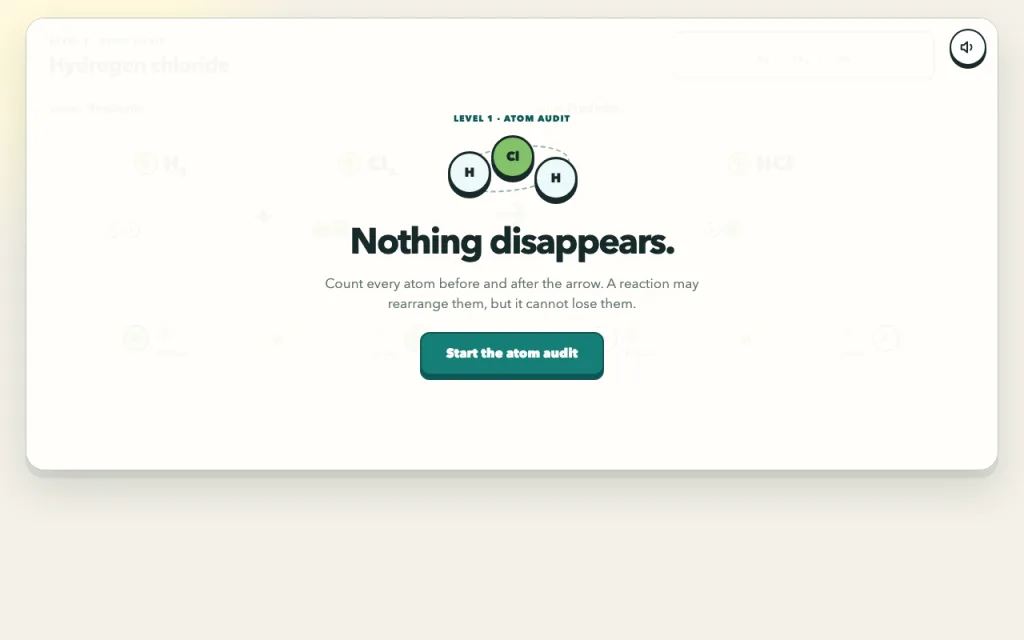 Chemistry · Ages 11-13Reaction Balancer
A chemical reaction rearranges atoms but does not create or destroy them, so a correct equation has the same number of each kind of atom before and after the reaction.
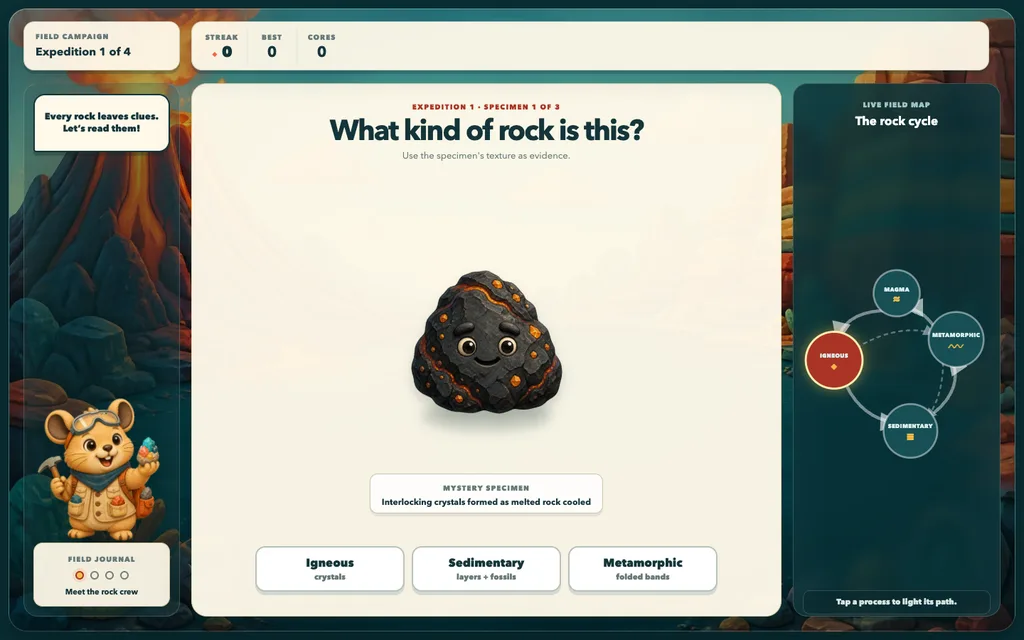 Earth Science · Ages 8-13Rock Rover
Rock types are stages in a cycle: cooling makes igneous rock, surface weathering plus deposition and cementing makes sedimentary rock, heat and pressure make metamorphic rock, and melting returns rock to magma.
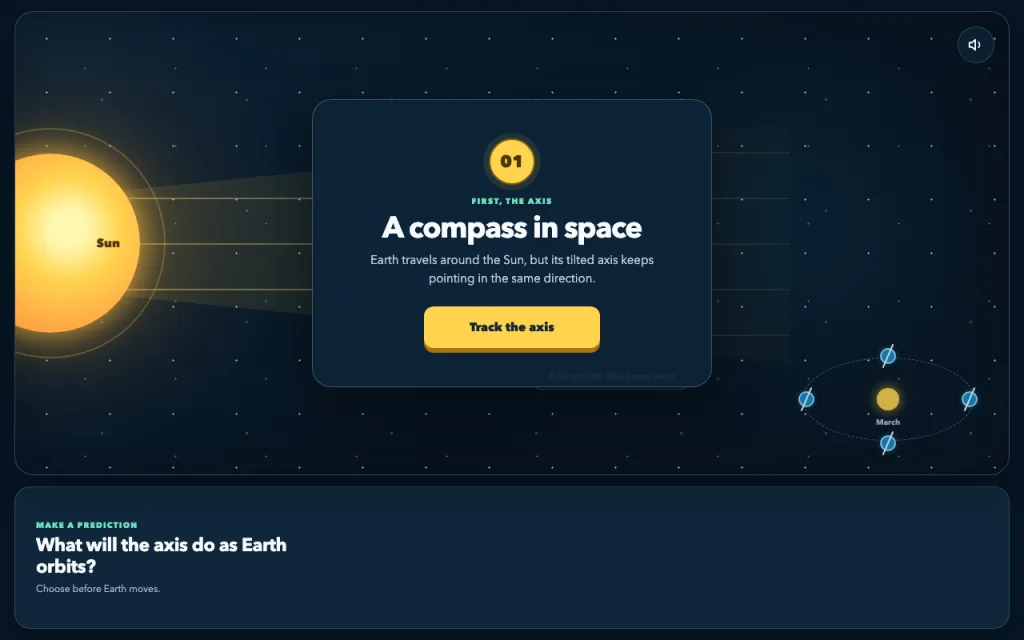 Earth Science · Ages 10-13Seasons Globe
Earth's fixed axial tilt changes how directly sunlight hits each hemisphere: direct light is concentrated, while slanted light spreads the same energy over more area and heats less.
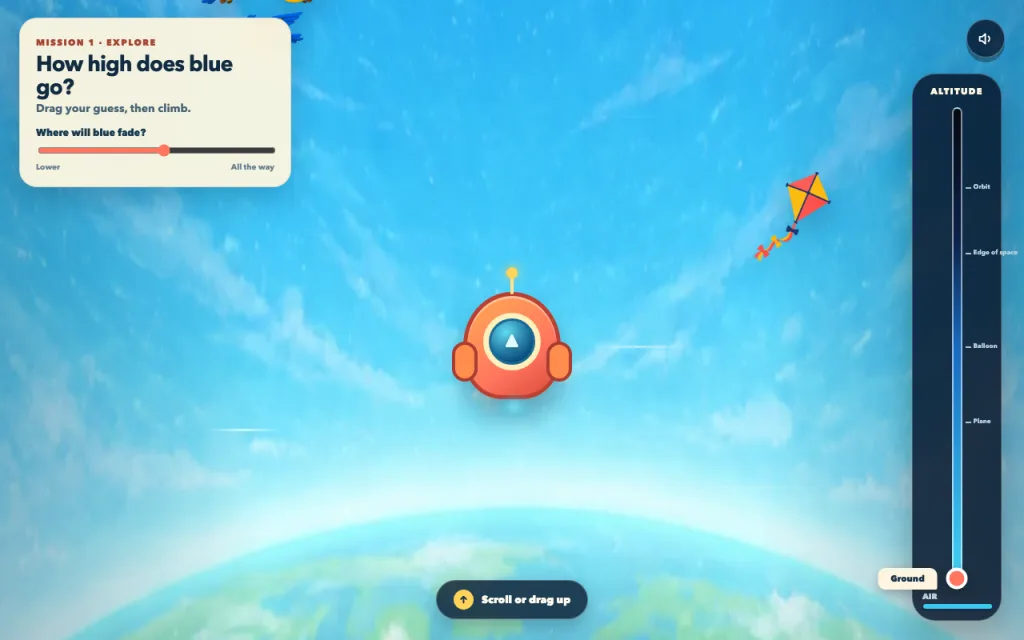 Earth and Space Science · Ages 7-12Sky High
As altitude increases, Earth’s air gets gradually thinner: birds and airplanes need enough air, balloons rise into thin air, and satellites orbit above almost all of it.
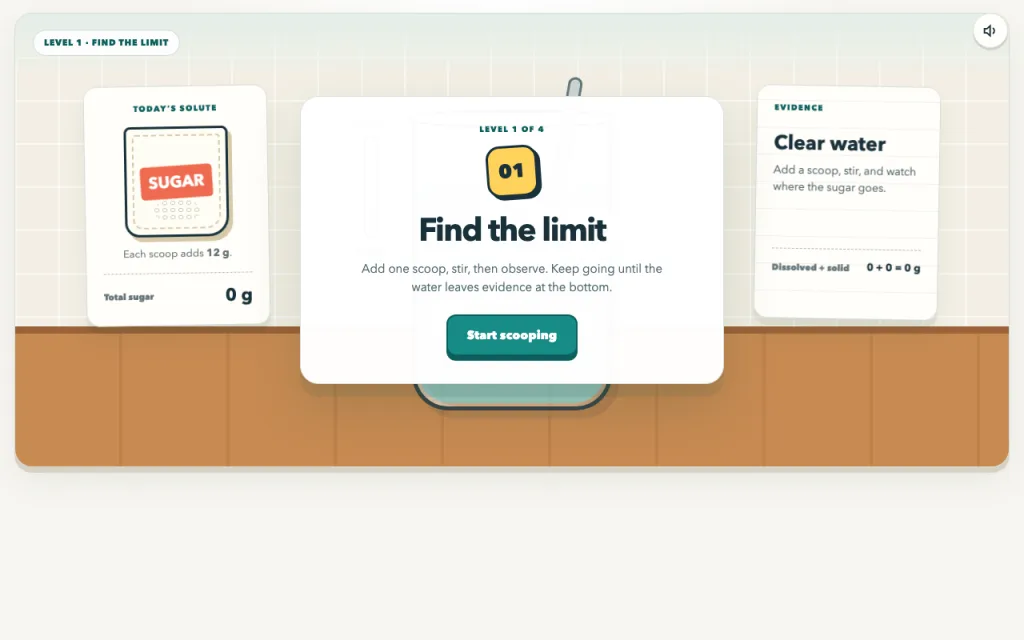 Chemistry · Ages 10-13Solubility Kitchen
A liquid can dissolve only a limited amount of solute at a given temperature. Heating usually raises that limit, while cooling can make some dissolved solute become solid again.
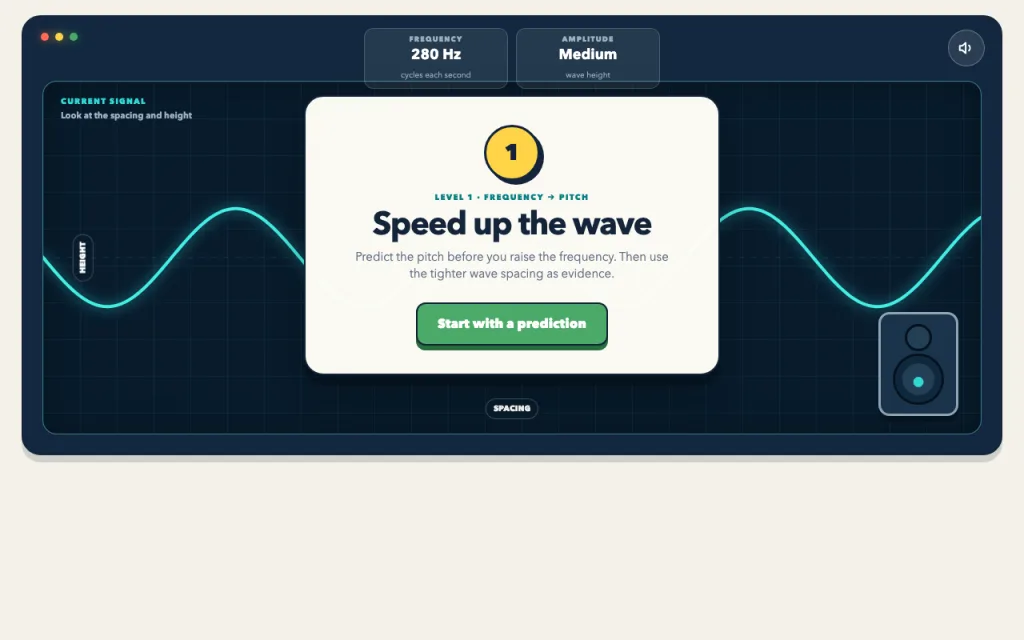 Physics · Ages 10-13Sound Mixer
Frequency controls pitch and amplitude controls loudness; either one can change without changing the other.
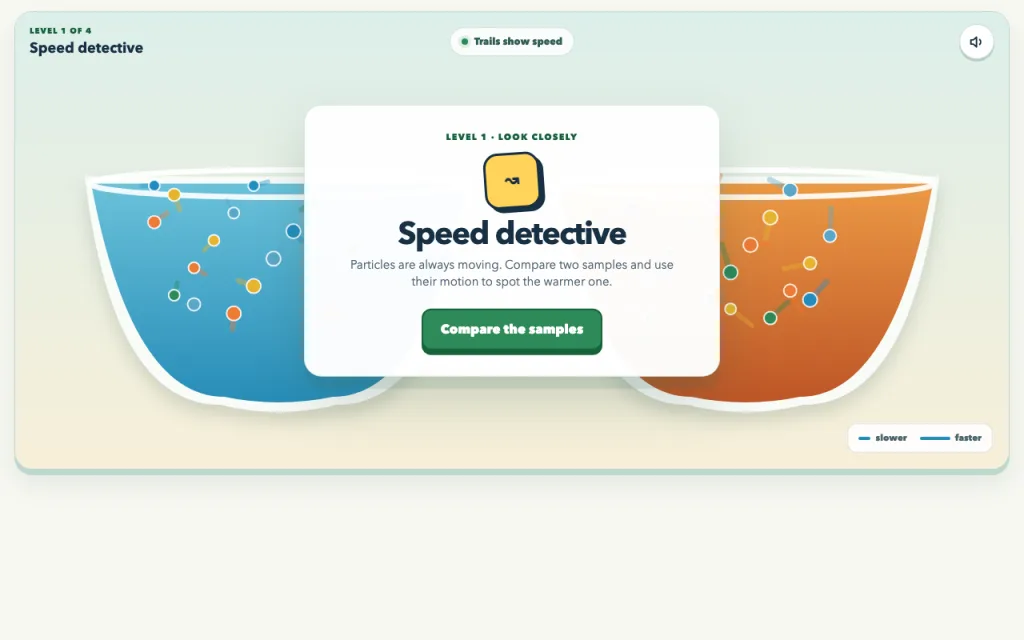 Chemistry · Ages 10-13Soup Molecules
Heating gives particles more energy, so they move faster on average; the fastest particles at a liquid's surface can escape as vapor, which is evaporation and can cool the liquid left behind.
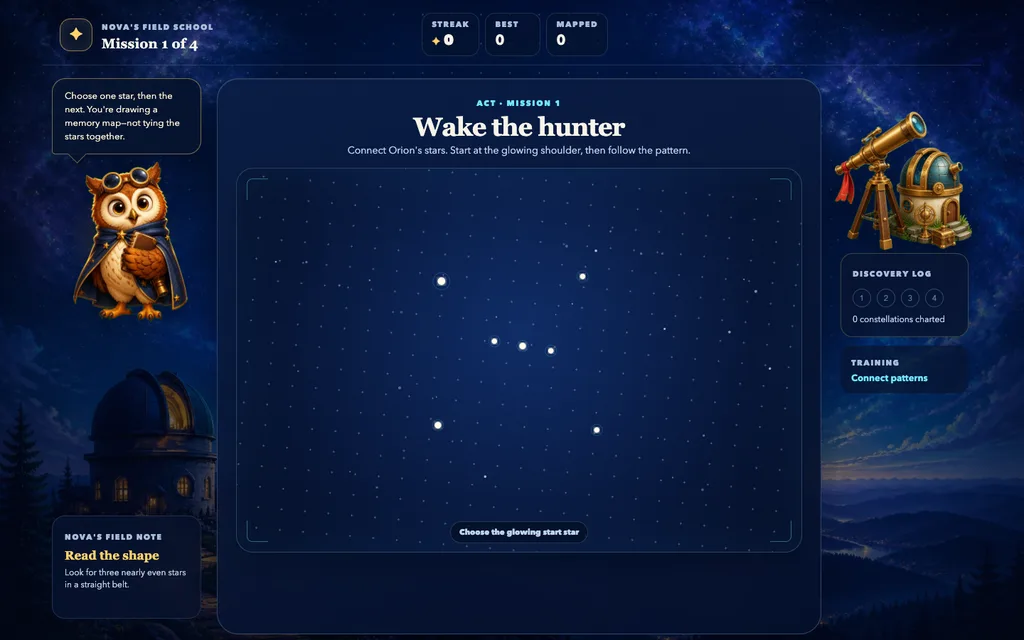 Science · Ages 7-13Star Mapper
Constellations are recognizable patterns we see from Earth: their stars are real, but the connecting lines are imaginary guides, and hemisphere and season change which patterns are easiest to find.
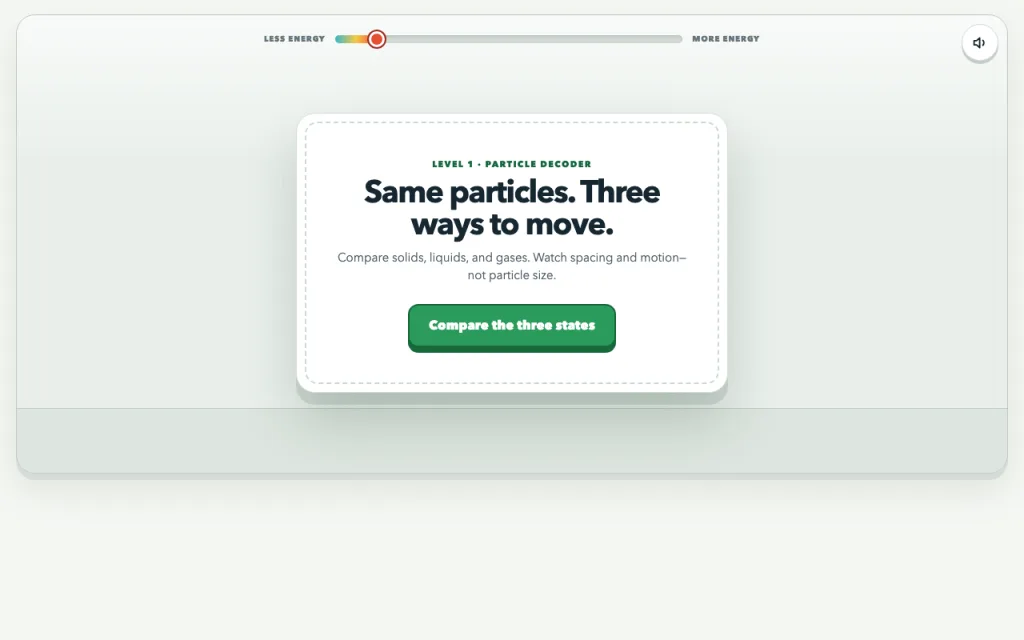 Chemistry · Ages 9-12States of Matter Chamber
Solids, liquids, and gases contain the same-sized particles with different amounts of energy: heating makes particles move faster and more freely, while cooling makes them slow down and lock closer together.
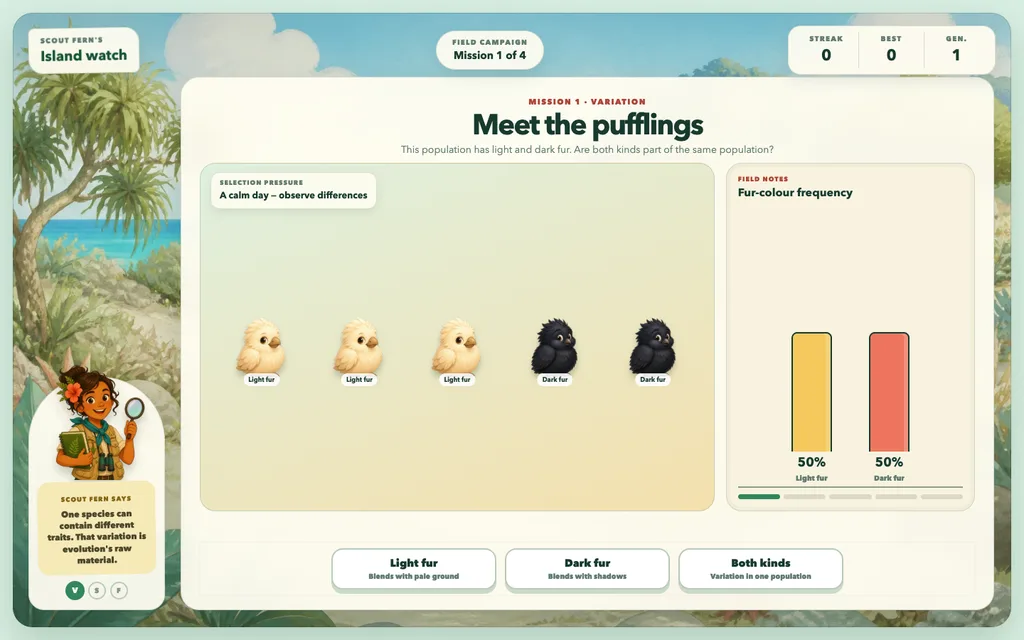 Biology · Ages 10-13Survive the Island
Inherited traits vary within a population; when an environment lets better-suited individuals survive and reproduce more, those traits become more frequent over generations, so the population evolves.
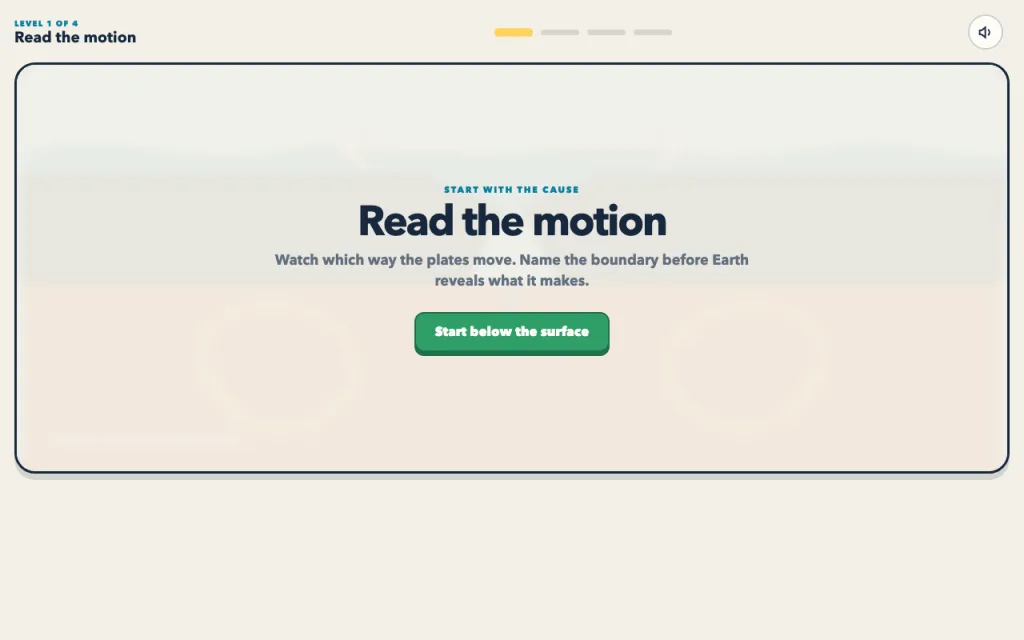 Earth Science · Ages 10-13Tectonics
Tectonic plates keep moving, and pulling apart, pushing together, or sliding past creates predictable patterns of ridges, mountains, volcanoes, and earthquakes.
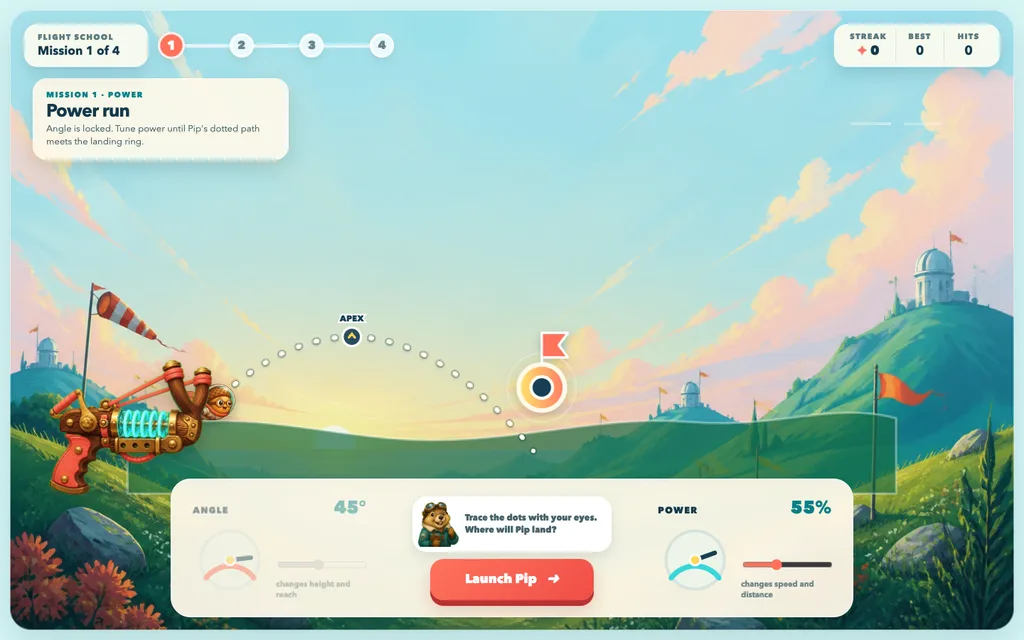 Physics · Ages 11-13Trajectory Launch
A projectile's launch angle and power determine a predictable parabolic path; the apex and landing point can be read from that curve and represented by a quadratic equation.
Science · Ages 4-9Weather WatchWeather clues such as clouds, temperature, wind, and repeating observations help us describe current conditions, prepare sensibly, and make simple forecasts that are predictions rather than promises.
Every game comes with Ako.
Ako is a voice AI tutor who lives inside the lesson — he sees what your child builds, asks what they think will happen, and never just gives the answer. Then he writes to you each week about what clicked. Covers the concepts kids meet in elementary and middle school.
Questions parents ask
What science topics are covered?
Volcanoes and plate tectonics, atoms and reactions, orbits and gravity, food webs, the human body, ocean zones, states of matter, sound and waves — and more every month.
Is the science accurate?
Yes — and by design. Ako can only act through each lesson's fixed rules, so he can't make things up. The simulation is the authority.
What ages are they for?
Built for ages 7–12 (grades 2–6), with Ako adapting his language to your child.
Let your kid try one.
One free lesson. No account. If they don’t ask to keep going, don’t subscribe.
Try a lesson free$15/month after · cancel anytime