The best fraction games in 2026
Fractions are the first place math gets abstract, and the research is blunt: kids who see fractions as areas and lengths — not just symbols — do better for years afterward. Every game on this list keeps the picture attached to the number.
Fractions overturn several rules children trust about whole numbers. A larger denominator makes unit pieces smaller, two differently written fractions can name the same amount, and numbers now live between counting numbers. Kids often compare 1/8 and 1/6 by choosing eight because it is larger. Understanding usually deepens across grades 3 through 5 when area models are joined by number lines: the child sees that a fraction is not just a shaded slice, but a number with a precise location and size.
A strong fraction game keeps the symbols tied to quantities children can change. Look for equal partitioning, number-line placement, and opportunities to predict whether two pieces cover the same amount before checking. The whole must stay consistent, since comparing slices from differently sized wholes creates confusion. Games that reward adding numerators and denominators or racing through isolated facts can rehearse errors efficiently. Good feedback shows the changed area or length and asks the child to account for equivalence, not merely accept a green check.
Use fraction games for fifteen minutes, then ask your child to show one answer in a second way: as a picture, a number-line point, or an equivalent fraction. Useful questions are, “What is the whole?” and “How big is one part?” At the kitchen table, fold two equal paper strips into fourths and eighths. Match 2/4 with 4/8, then cut one strip and combine pieces to make new totals without changing the size of the original whole.
Top picks for 2026
1. Fraction Slice: Pizza Parlor
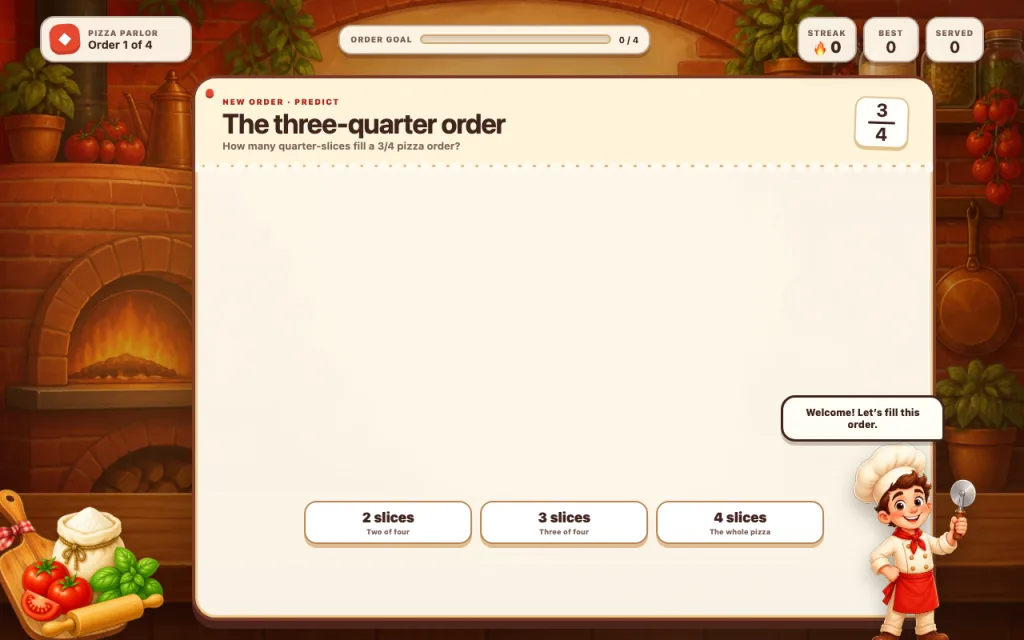
Fraction Slice: Pizza Parlor puts your child behind the counter cutting real orders — build 3/4, prove 6/8 covers the same pizza, add halves to quarters without ever adding denominators. Ako, the voice AI tutor, asks for the prediction before every cut. Ages 8–13, first lesson free. (We also have Fraction Kitchen and Fraction Wall for younger and older kids.)
Common questions
What order should kids learn fractions?
Equal parts and naming first (grade 3), equivalence and comparing (grades 3–4), then adding with like and unlike denominators (grades 4–5). Games that skip straight to symbol arithmetic build fragile skills.
Why do kids find fractions hard?
Because 1/4 looks bigger than 1/3 if you only read symbols. Until the area picture is automatic, every rule feels arbitrary. That's why every game we recommend keeps the visual attached.
Can I try a fraction game free?
The first lesson is free in the browser, with no account required. A subscription unlocks all three fraction lessons and the rest of the 100+ catalog.