The best moon phases games in 2026
Almost every adult secretly holds a wrong model of moon phases (no, it's not Earth's shadow). The best moon phases games fix the model young by letting kids move the moon themselves and watch the lit shape change.
Moon phases demand three-dimensional thinking from a two-dimensional view in the sky. Children often blame Earth’s shadow, think the moon makes its own light, or assume the phase depends on clouds. The key is holding two views at once: half the moon is lit by the sun, while an observer on Earth sees different portions of that half during the orbit. This usually clicks in upper elementary school when kids physically change the moon’s position and keep the sun fixed.
A good moon phase game must connect the overhead arrangement of sun, Earth, and moon with the phase seen from Earth. Look for a movable orbit, a fixed light source, prediction before movement, and views that can be compared. A row of phase pictures to memorize may teach sequence but leaves the shadow misconception intact. Better feedback shows which half is illuminated and lets the child rotate, reverse, and test the model until waxing, waning, full, and new are consequences rather than vocabulary.
Spend about fifteen minutes exploring no more than one lunar cycle. Before moving the moon, ask, “Which part is lit, and how much of that part can we see from Earth?” At the kitchen table, darken the room and use a lamp as the sun and a ball as the moon. Your child can hold the ball at arm’s length and turn slowly, naming the phases while you check that their own head is not casting the shadow.
Top picks for 2026
1. Moon Phases Lamp
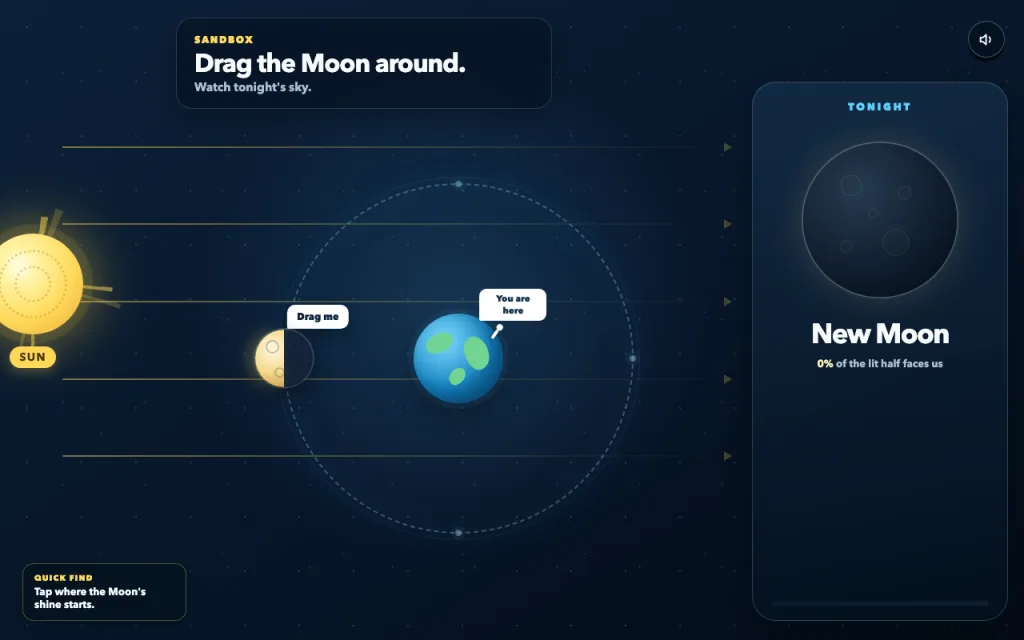
Moon Phases Lamp gives your child a lamp for a sun, a moon on an orbit, and an eye on Earth. Drag the moon around and the phase updates live; make a full moon, carve a thin crescent, then reverse the view and predict what an astronaut would see. Ako, the voice AI tutor, gently dismantles the shadow misconception. Ages 9–12, first lesson free.
Common questions
What causes moon phases?
The moon is always half-lit by the sun; the phase is just how much of that lit half faces Earth as the moon orbits us. It is not Earth's shadow — that's an eclipse, and it's the single most common misconception these games exist to fix.
What age do kids learn moon phases?
Typically grades 4–6 (ages 9–12), revisited in middle-school astronomy.
Is Moon Phases Lamp free?
First lesson free in the browser, no account. A subscription unlocks the full catalog including Orbit Lab and Seasons Globe.