The best angles games in 2026
Angles are one of the most game-able topics in math — they're visual, physical, and instantly checkable. These are the angle games worth a child's time in 2026, from first 'acute vs obtuse' calls to protractor fluency.
Children often judge an angle by the length or direction of its arms instead of the amount of turn between them. A narrow angle with long rays can look “bigger” than a wide angle with short rays, and a rotated right angle may stop looking right. The concept usually clicks around grades 4 and 5 when kids use 90 degrees as a dependable benchmark, estimate first, and understand that rotation and ray length do not change the angle’s measure.
The best angle games let children rotate a ray, commit to an estimate, and then measure the result. Look for varied orientations, a clear 90-degree reference, and protractors whose center and baseline must be aligned rather than magically placed. Useful feedback shows whether an estimate was high or low. Classification quizzes alone are too shallow, while games that reveal the measurement before the guess turn protractor use into copying instead of building the visual sense that makes measurement meaningful.
Play for ten to fifteen minutes, mixing estimation with exact measurement so neither becomes a separate trick. Ask, “Is it closer to 90 or 180 degrees?” and “What would happen if we rotated the whole shape?” At the kitchen table, use two drinking straws as rays. Have your child make an angle, estimate it, and check with a protractor or folded paper benchmarks. Then swap roles and ask them to coach your deliberately bad estimate.
Top picks for 2026
1. Angle Architect
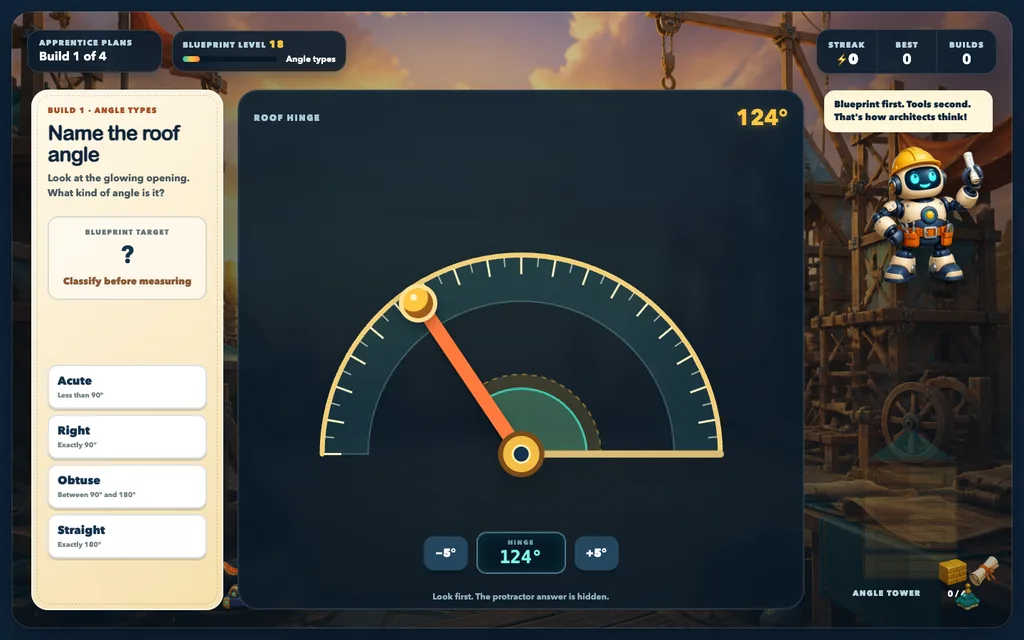
Angle Architect makes your child the apprentice on a build site: classify the roof angle, then measure it, then set a rafter to exactly 124°. The protractor answer stays hidden until they commit, so every level is a prediction first. Ako, the voice AI tutor, talks through what acute and obtuse actually mean. Ages 9–13, first lesson free.
Common questions
What grade do kids learn angles?
Angle types (acute, right, obtuse) usually arrive in grade 4, measuring with a protractor in grades 4–5, and angle relationships in middle school.
How do games help with angles?
Estimation before measurement. Games force a guess — 'is that more or less than 90°?' — and the instant visual feedback calibrates a child's eye far faster than worksheet measuring does.
Is Angle Architect free?
First lesson free in the browser, no account. A subscription unlocks the full Ako catalog.