Fun math games for 9 year olds
4th grade scales everything up: multi-digit multiplication, long division with one-digit divisors, fraction equivalence and addition, decimals meeting fractions, and angles measured for the first time. It's also the year math anxiety tends to start — hands-on wins matter more than ever.
The short hand shows the hour and the long hand counts minutes around the clock; reading or setting both hands together makes one exact time.
Shape SpaceMathematics · Ages 5-10A shape keeps its identity when it turns, changes size, or appears as an everyday object; its straight sides and corners identify a 2D shape, while faces, edges, vertices, and curved surfaces identify a 3D solid.
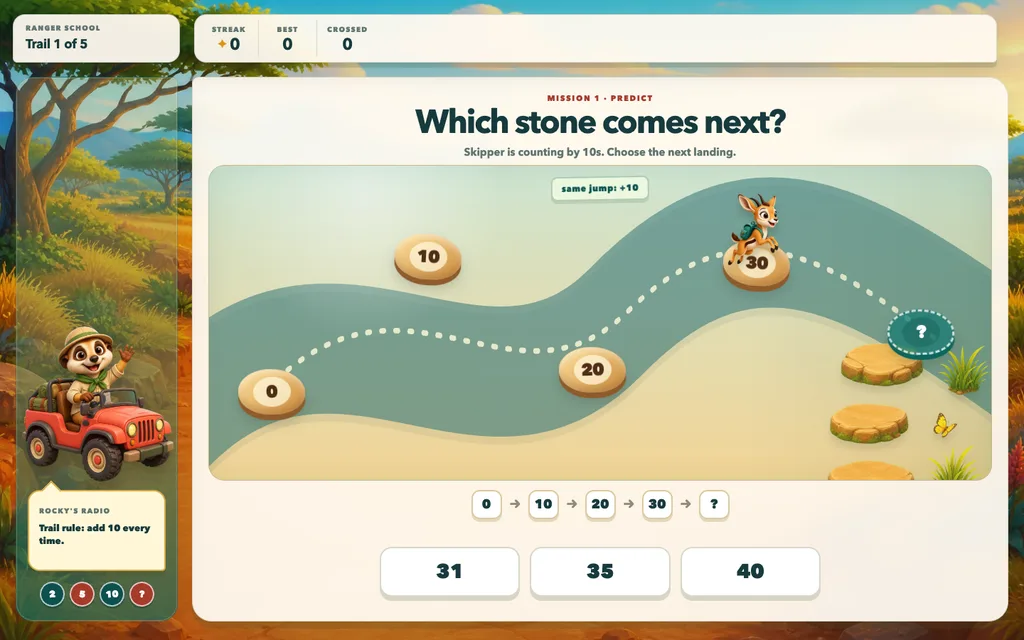 Skip Count SafariMathematics · Ages 5-9
Skip-counting makes equal jumps on the number line; each landing adds the same amount, so the number of jumps connects directly to multiplication.
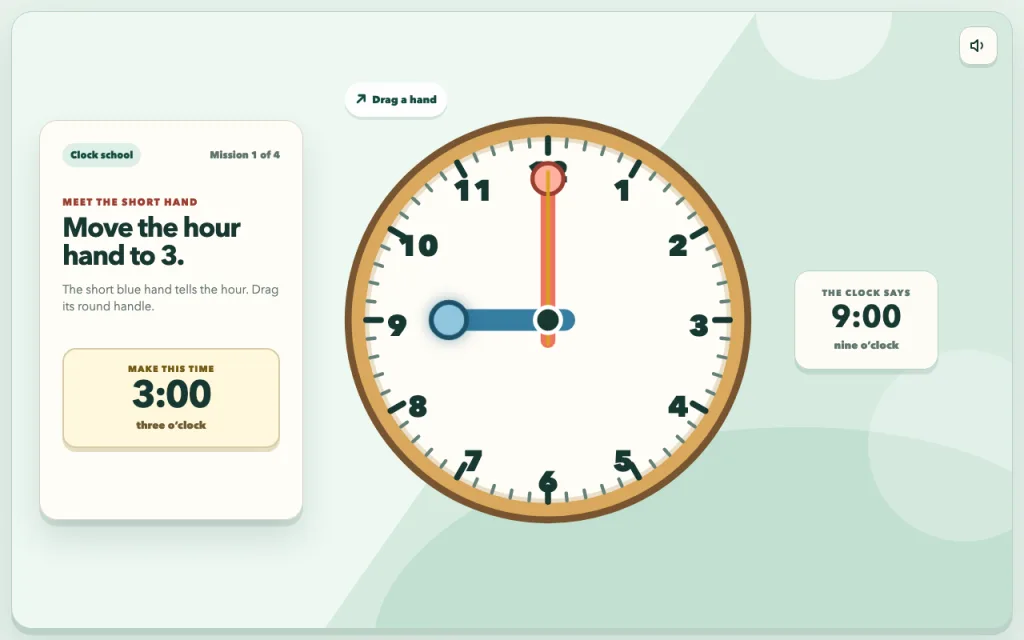 Clock WorkshopMaths · Ages 6-11
A clock’s short hand points to the hour and its long hand points to the minutes; reading both hands together tells the time.
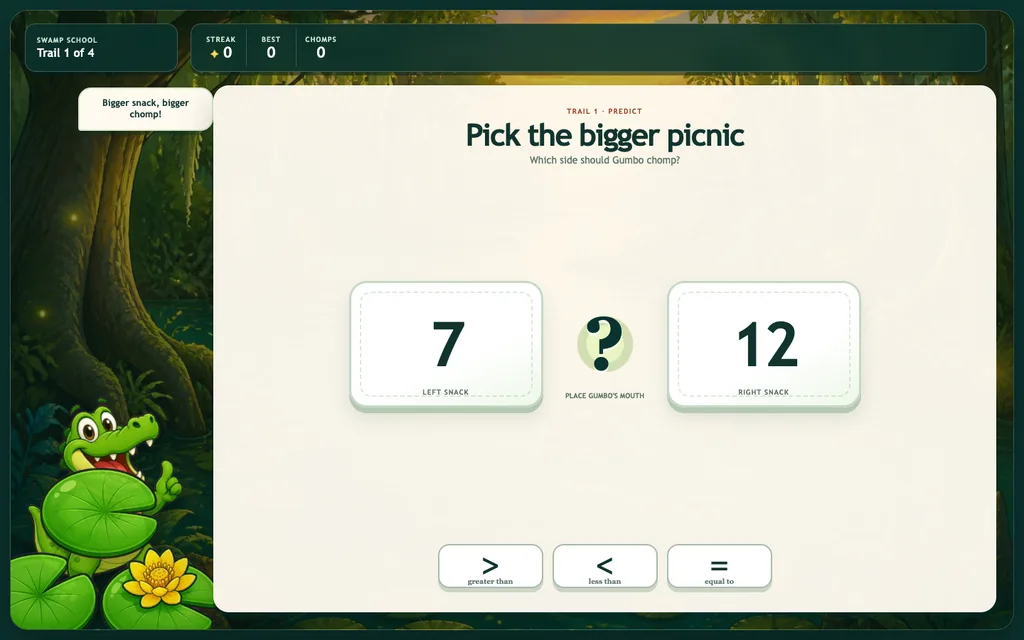 Gator ChompMathematics · Ages 6-10
The symbols > and < open toward the greater value, while = shows equal values; comparing place values lets us use the same relationship for whole numbers, decimals, fractions, and ordered sets.
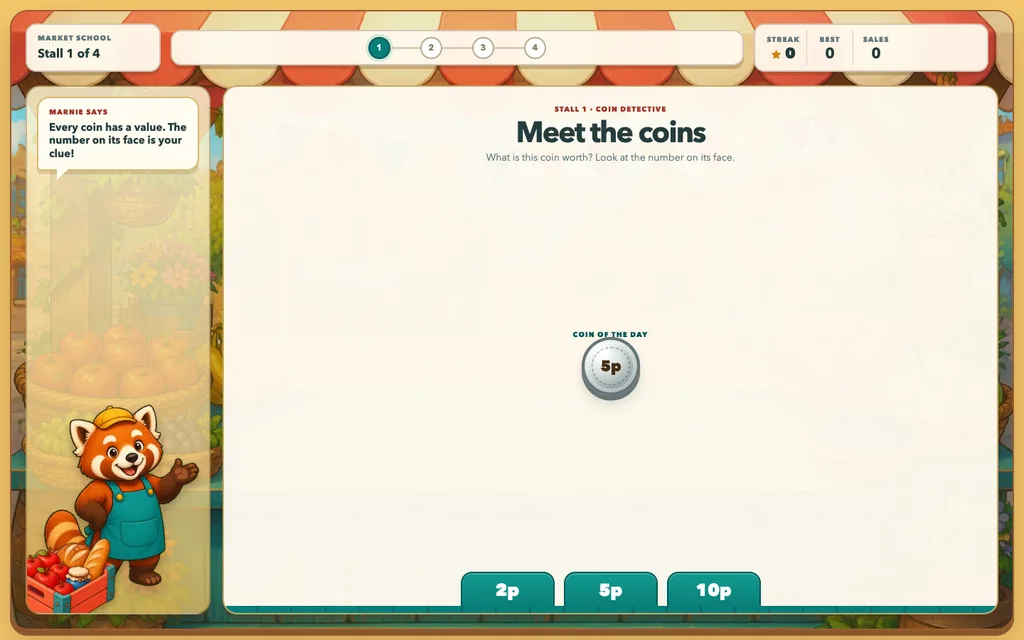 Money MarketMathematics · Ages 6-10
Money amounts are totals of coin and note values; exact payment matches a price, while change is the difference between what was paid and what it cost.
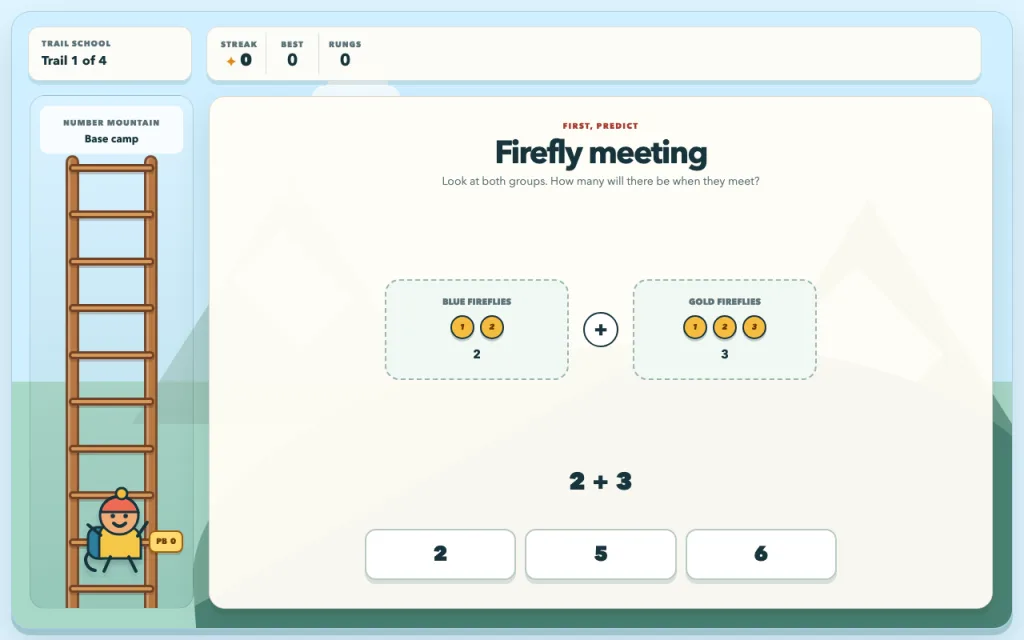 Number LadderMaths · Ages 6-11
Adding combines every member of two or more groups into one total; the groups change arrangement, but no members disappear.
Times Table ArenaMathematics · Ages 6-11A multiplication fact counts equal groups: a × b is a equal rows with b in each row, and the product is the total across every row.
Area & Perimeter ParkMathematics · Ages 7-12Area counts the square units inside a shape, while perimeter measures the unit lengths around its outside boundary; equal areas can have different perimeters.
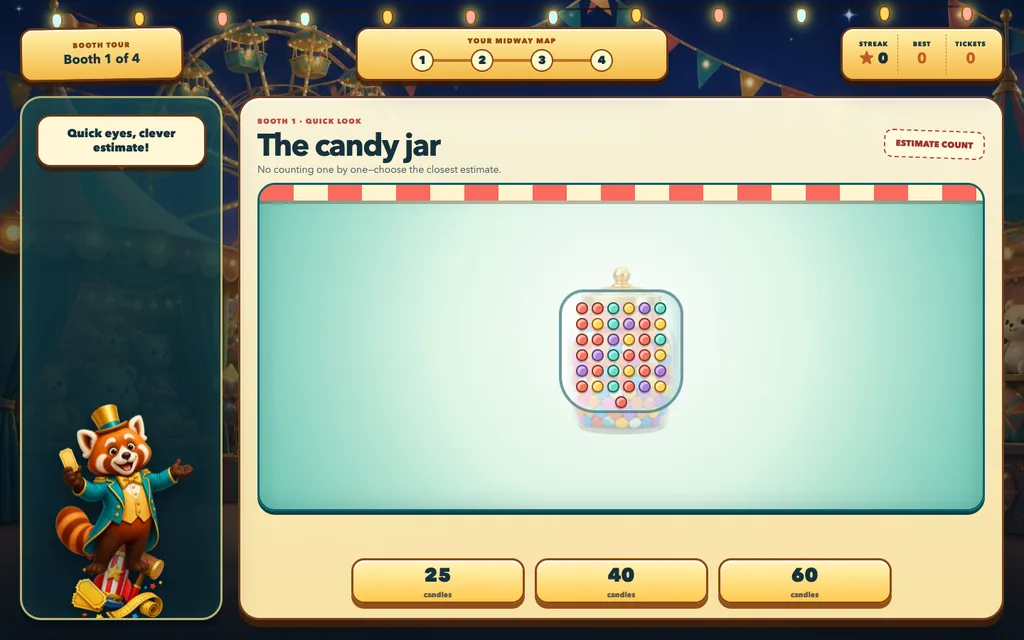 Estimation StationMathematics · Ages 7-12
A useful estimate is a nearby, quick answer made with groups, familiar benchmarks, or rounded numbers; comparing it with the actual result helps us judge whether an answer is reasonable.
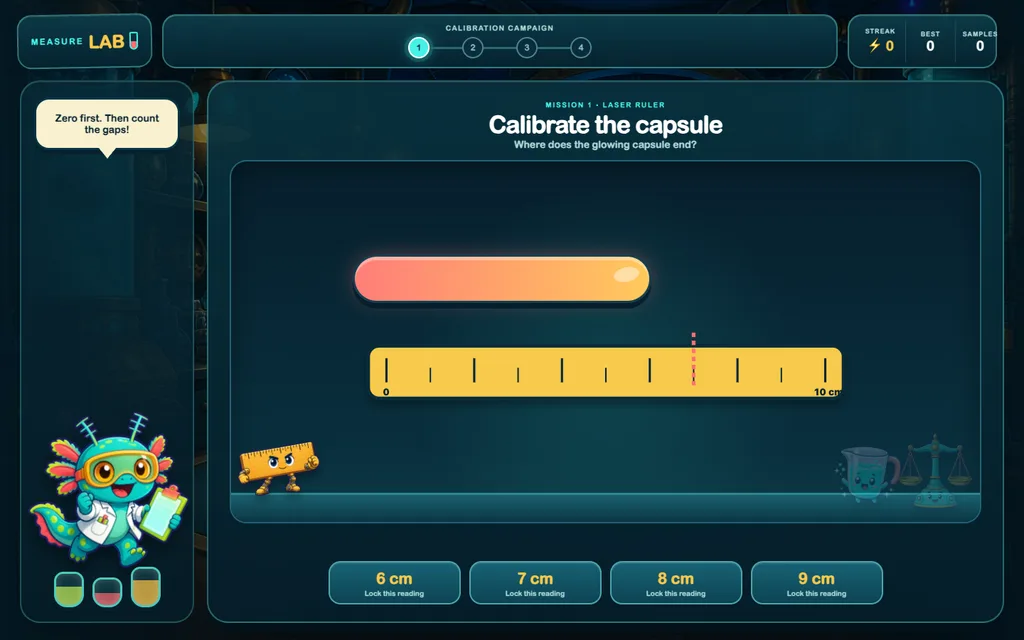 Measure LabMathematics · Ages 7-12
Measurements pair a number with a unit; instrument marks show equal intervals, and converting units changes the number without changing the amount.
Story ProblemsMathematics · Ages 7-12The action in a story tells us which operation connects its numbers; representing that action as a number sentence makes the answer explainable.
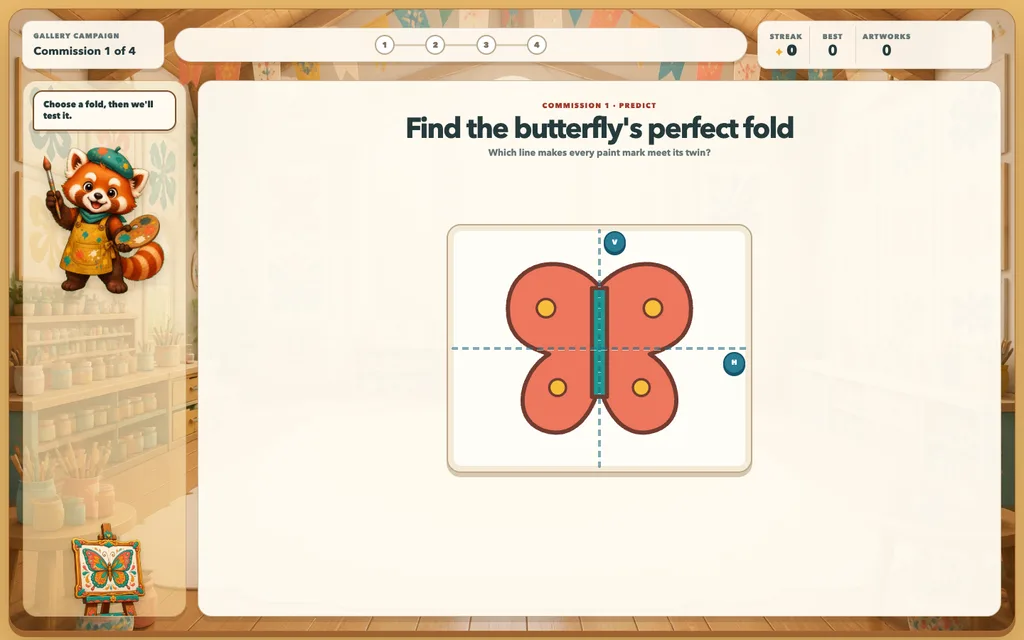 Symmetry StudioMathematics · Ages 7-12
A line of symmetry is a fold line that pairs every point with a matching point the same perpendicular distance on the other side; a shape can have none, one, or several such lines.
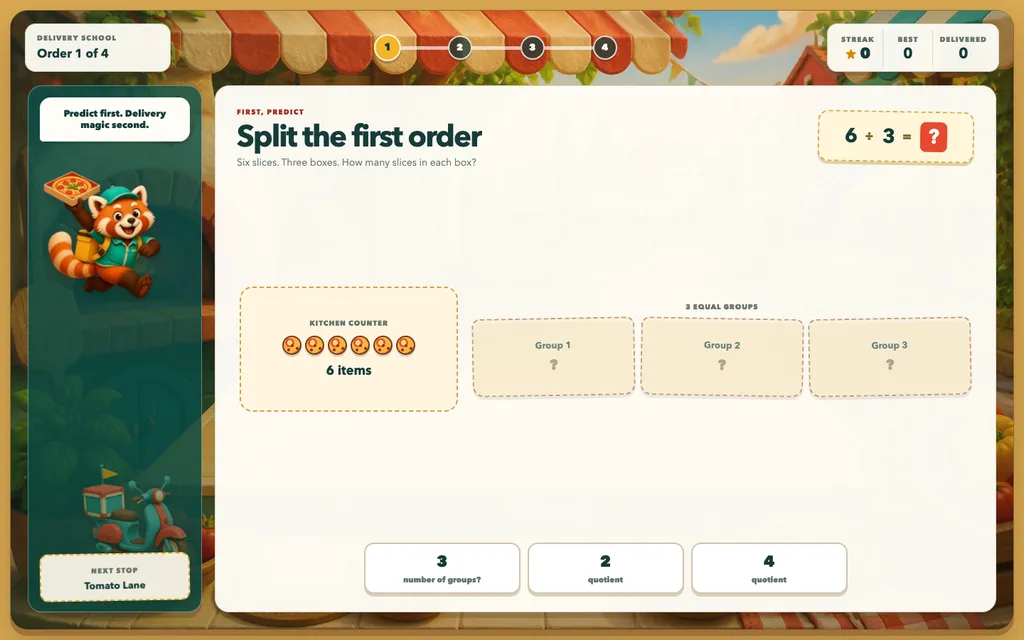 Division DashMathematics · Ages 8-12
Division shares a total equally: the quotient tells how many belong in each group (or how many equal groups can be made), and any amount left over is the remainder.
Fraction FlipMathematics · Ages 8-13A fraction, decimal, and percent can name the same amount; equivalent forms fill exactly the same length of one whole.
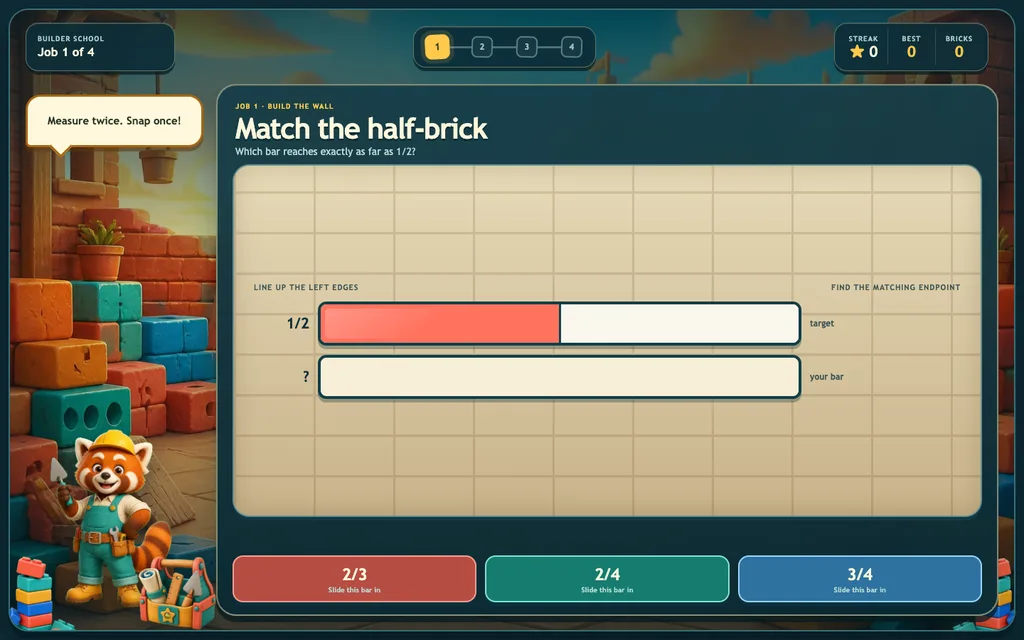 Fraction WallMathematics · Ages 8-13
Fractions are equivalent when they cover the same length of the same whole; lining bars up makes equivalence, comparison, and simplification visible.
Grid RangerMathematics · Ages 8-13An ordered pair (x, y) names one exact point by giving a horizontal x move from the origin first, followed by a vertical y move; negative values reverse those directions.
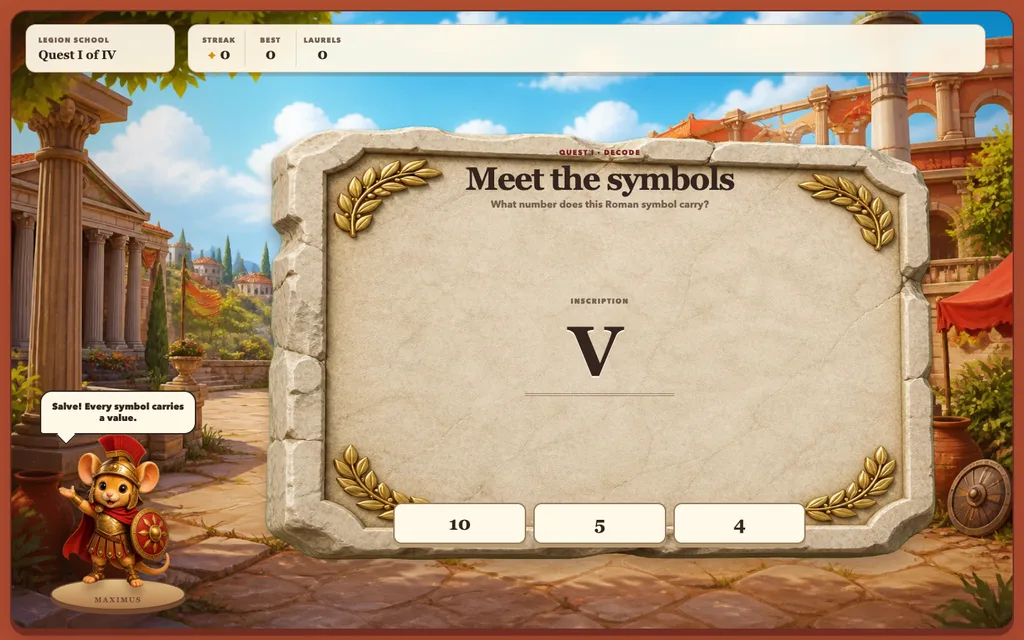 Roman QuestMathematics · Ages 8-13
Roman numerals use symbols with fixed values; reading from left to right usually adds them, but a smaller value before a larger value is subtracted.
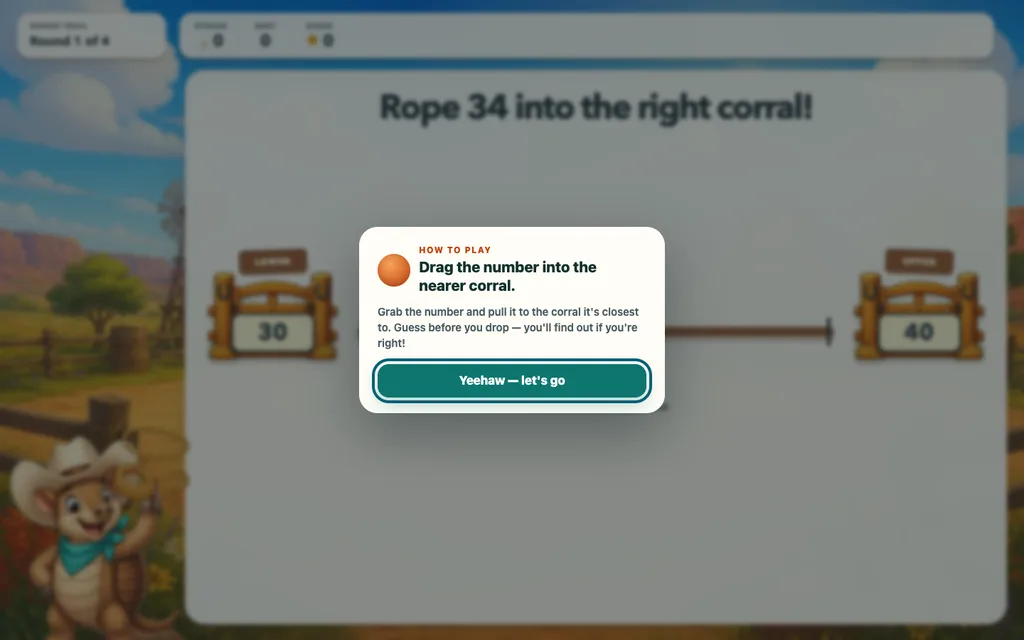 Rounding RodeoMathematics · Ages 8-12
To round a number, place it between two neighbouring round numbers and choose the closer one; an exact midpoint rounds up.
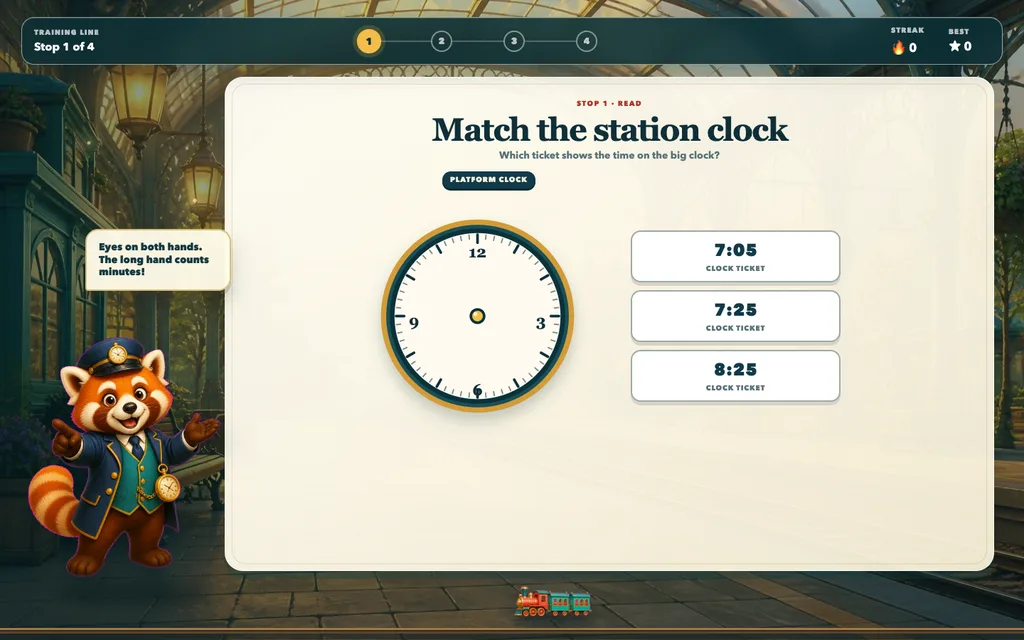 Time StationMathematics · Ages 8-12
Elapsed time is how far a clock moves forward from a start time to an end time; counting on through friendly hour boundaries makes that journey visible and reliable.
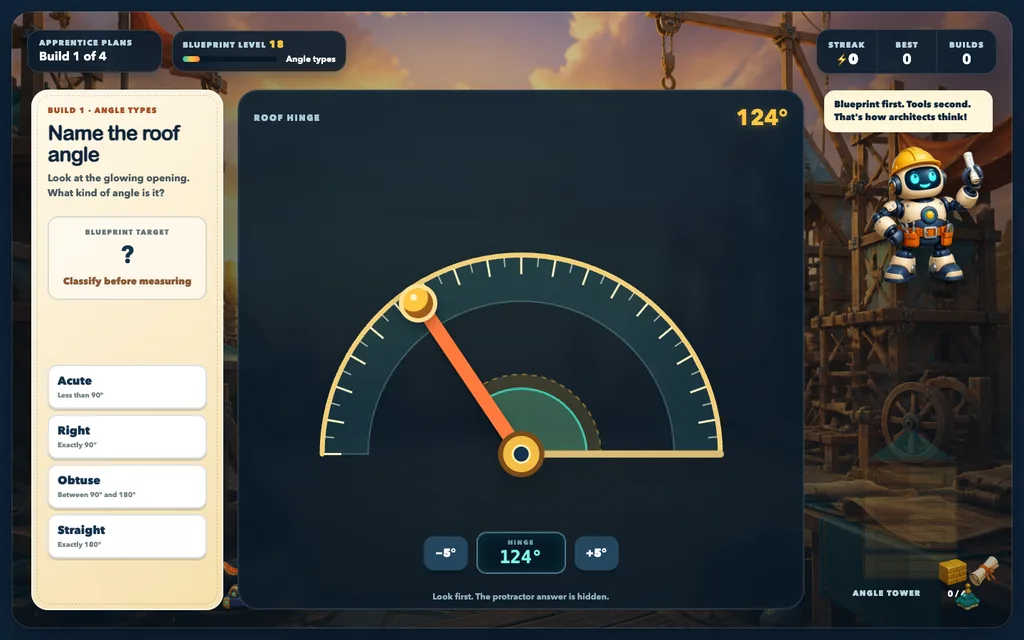 Angle ArchitectMathematics · Ages 9-13
An angle measures the amount of turn between two rays: angles range from acute through reflex, a protractor reads the inside turn from 0° to the degree, and missing angles can be found from 90°, 180°, and 360° totals.
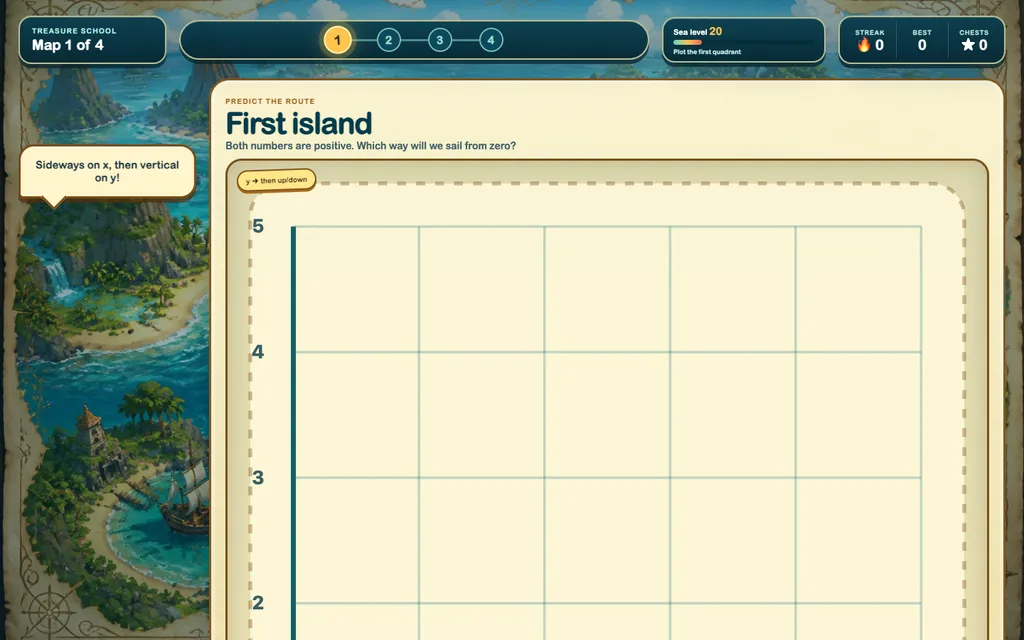 Coordinate QuestMathematics · Ages 9-13
A coordinate pair (x, y) gives an exact location: move horizontally along x first, then vertically along y; negative values reverse the direction from the origin.
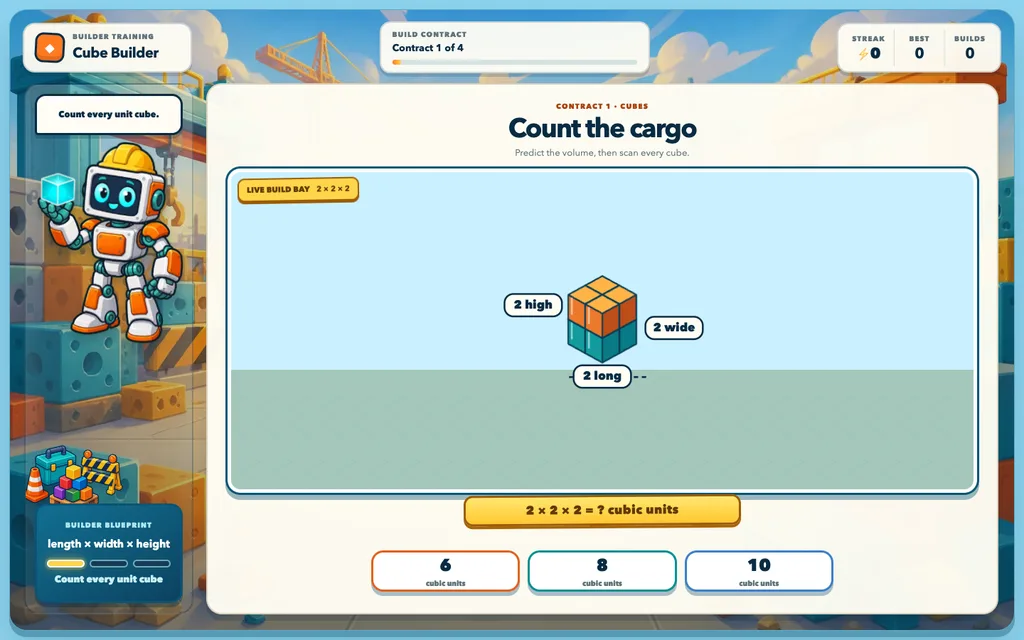 Cube BuilderMathematics · Ages 9-13
Volume is the number of unit cubes that fill a three-dimensional solid; equal layers show why length × width × height counts every cube inside.
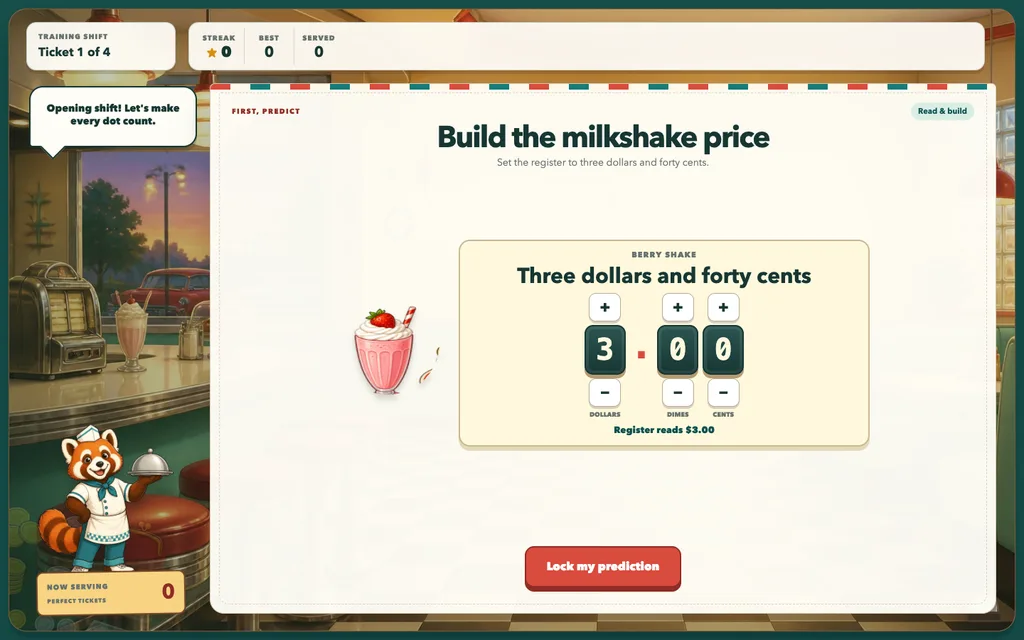 Decimals DinerMathematics · Ages 9-13
A decimal point anchors place value: decimals can be read, located, compared, rounded, scaled, added, and subtracted by tracking what every place is worth.
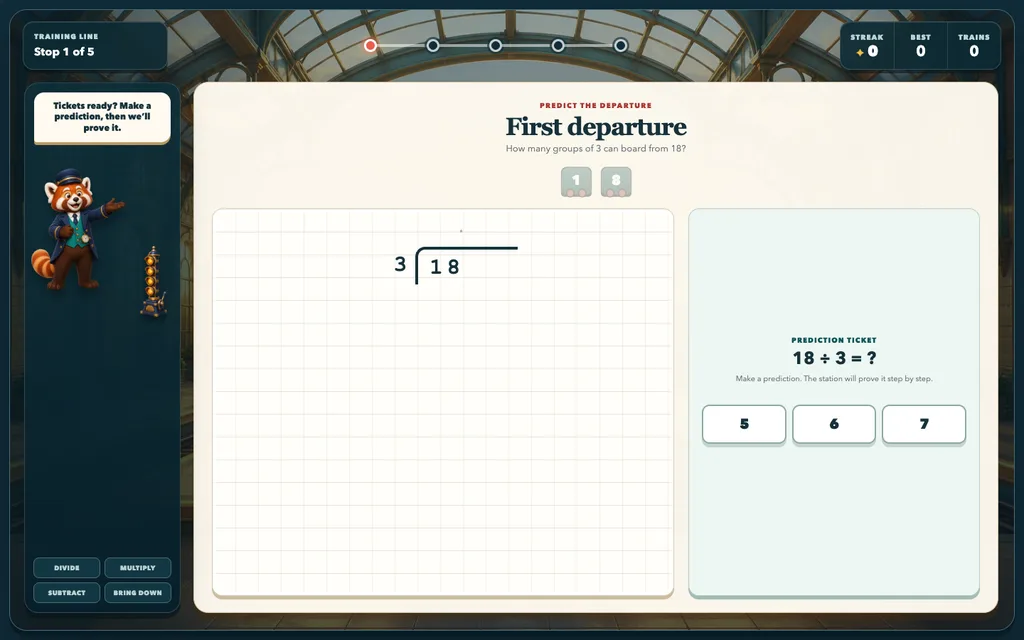 Division StationMathematics · Ages 9-13
Long division repeats divide, multiply, subtract, and bring down; each cycle fixes one quotient digit, and the final leftover is a remainder smaller than the divisor.
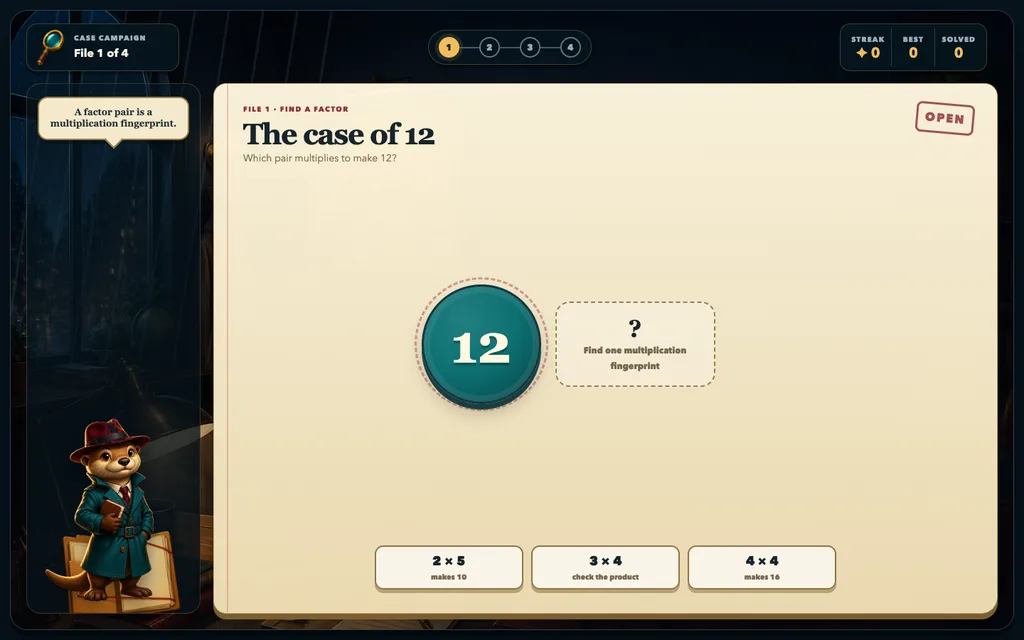 Prime DetectiveMathematics · Ages 9-13
A prime number has exactly two factors, 1 and itself; a composite number has additional factor pairs, which can be found by testing divisors only up to its square root.
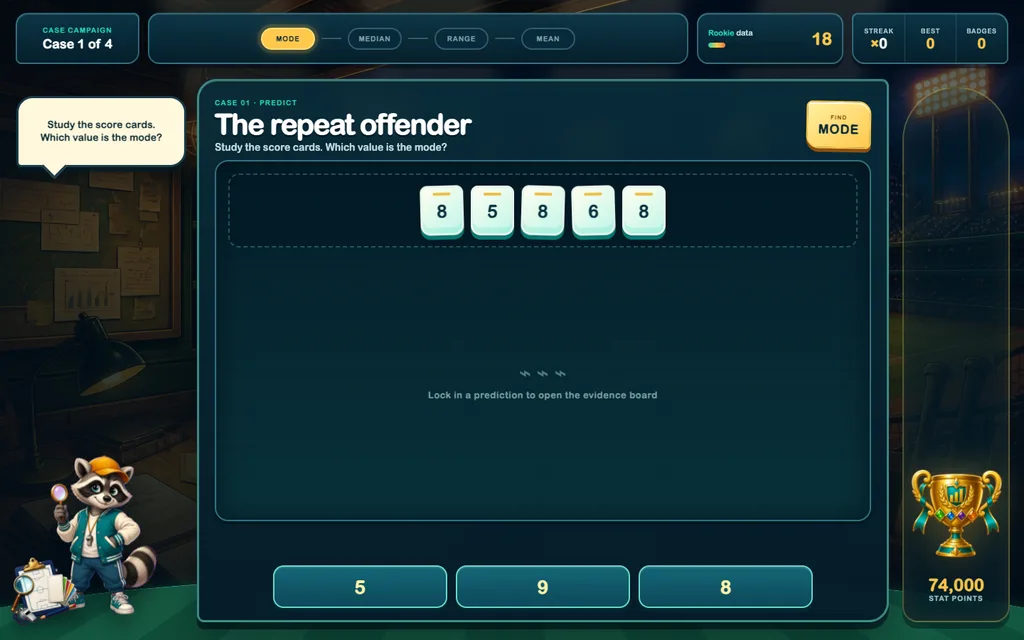 Stat SquadMathematics · Ages 9-13
Mean, median, mode, and range describe different features of the same data: equal share, ordered middle, most frequent value, and total spread.
Getting the most out of math games at this age
- Ten focused minutes beats forty distracted ones — stop while it's still fun.
- Ask 'how did you know?' after a right answer, not just a wrong one. The explanation is where the math lives.
- If a game frustrates, drop down a year without comment. Confidence compounds faster than difficulty.
Common questions
What math skills should 9 year olds learn?
4th grade scales everything up: multi-digit multiplication, long division with one-digit divisors, fraction equivalence and addition, decimals meeting fractions, and angles measured for the first time. It's also the year math anxiety tends to start — hands-on wins matter more than ever.
Are these games free?
Every Ako lesson here runs in the browser, and your first one is completely free — no account, no card. A subscription unlocks the full catalog of 100+ lessons.
How are Ako lessons different from other learning games?
Ako — a voice AI tutor — is inside every game. He sees what your child does, asks for predictions before they act, and adapts his coaching to their age. Parents get a weekly note about what actually clicked.